Brazil Legal Framework for Electronic Games: parental consent for child microtransactions (Lei 14.852/2024)
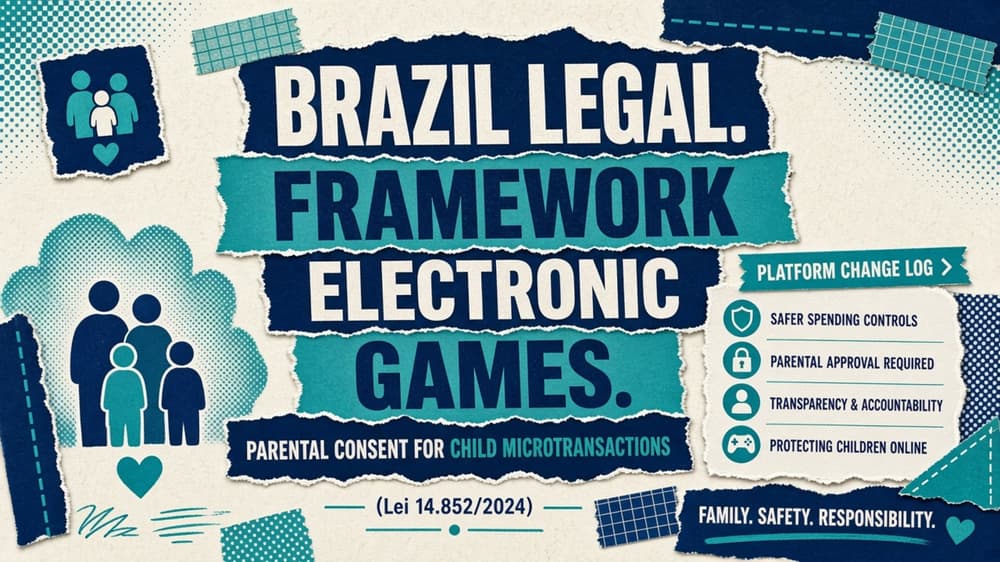
Lei 14.852 of 3 May 2024 Art. 17 requires in-game purchase tools to restrict child commercial transactions by default so guardians can consent — the pre-ECA Digital backdrop for later loot-box rules.
Brazil’s Lei nº 14.852 of 3 May 2024 (Marco Legal dos Jogos Eletrônicos), published in the Official Gazette on 6 May 2024, creates the industry framework. Art. 17 states that in-game purchase tools must, by default, restrict purchases and commercial transactions by children, when applicable, so as to guarantee the consent of those responsible.
Art. 1 §2 also requires indicative age classification to take into account risks related to microtransaction mechanisms. Art. 16 sets interaction safeguards for child/adolescent-directed games with messaging or content exchange. The law entered into force on its publication date (Art. 21).
How this sits under later ECA Digital rules
Lei nº 15.211 of 17 September 2025 (ECA Digital) Art. 20 separately prohibits loot boxes in electronic games directed at children and adolescents or likely to be accessed by them under the indicative classification. The 2024 Art. 17 consent duty remains the microtransaction gate; the 2025 Art. 20 ban is the loot-box layer.
| Field | Evidence |
|---|---|
| 2024 duty | Parental consent / default child purchase restriction |
| 2025 duty | Loot-box ban for child-directed or likely-accessed games |
| Not invented here | Specific technical age-assurance stack or UA CPI |
Preserve 2024 as the consent baseline when briefing Brazil soft-launch product and creative teams; do not rewrite it as a 2026 novelty.
Related posts

market intelligence
media buying
·1 min read
Lunar New Year UA gates from an official calendar, not a CPI myth

market intelligence
media buying
·2 min read
WeChat Mini Games upgrades 2026 IAP / virtual-payment incentives for debut titles

market intelligence
media buying
·2 min read