Playable tooling in 2026: build, buy or outsource
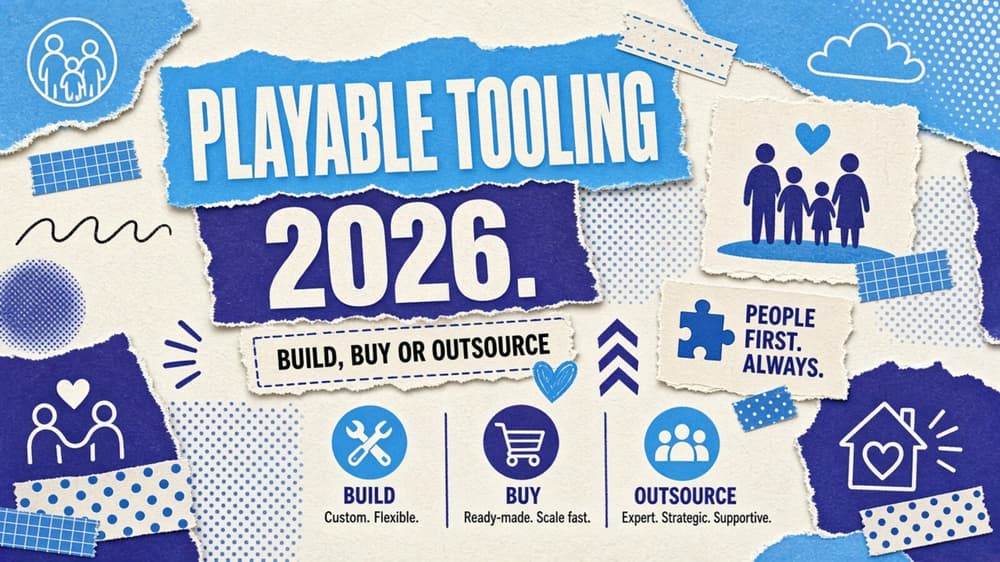
Network tools, in-house HTML5 pipelines and outsourced studios trade cost against ownership of the source. No single answer fits every studio.
A studio deciding how to produce playable ads in 2026 is choosing between three genuinely different models, not shopping for the best version of one. Network-provided tooling in the style of Playturbo or Luna, an in-house HTML5 pipeline built and maintained by the studio's own engineers, and fully outsourced production through a specialist studio all solve the same brief, a working playable that clears network QA, but they trade cost and speed and ownership against each other in different proportions. The right choice depends more on a studio's production volume and creative ambition than on which tool tests best in a demo.
Network tooling: fast, but the source stays with the vendor
Tools offered directly by ad networks or dedicated playable-tooling vendors exist to get a competent build live with minimal engineering involvement, usually through a template-driven editor aimed at marketers rather than developers. This is the fastest route to a first playable. It's also the cheapest per unit for a studio without dedicated playable engineering capacity. The trade-off shows up later: templates constrain how far a concept can deviate from the tool's assumptions, and the vendor's own framework frequently owns or wraps the underlying build, which makes migrating an existing library of playables to a different tool or network more painful than it should be. A studio that leans entirely on one vendor's tool for several years can find itself with a creative history whose source it doesn't fully control.
In-house HTML5: slower to start, compounds over time
Building and maintaining an internal HTML5 or lightweight-engine pipeline is the most expensive option up front, since it requires engineering hires or time that a marketing-tool subscription does not, and the first few playables produced this way often take longer to ship than an equivalent build through a network's own editor. The payoff compounds. A mature in-house pipeline owns every asset and every framework decision, along with every piece of instrumentation, which means a studio that has invested in this route for a year or two typically iterates faster than either alternative, because changes don't have to route through a vendor's template constraints or an outsourced studio's queue. This is the model that tends to make sense once a studio's creative volume is high and steady enough to keep dedicated engineering time justified.
Outsourcing: buying craft without buying a team
A specialist outsourced playable studio sits between the other two on most axes. Build quality and creative range are usually higher than template-driven network tools because a human production team, not a constrained editor, is doing the work; turnaround is slower than either in-house iteration or a self-serve tool, and cost per unit is the highest of the three once you account for volume. Ownership of the source code is a contract term rather than a default. Studios engaging an outsourced partner should confirm explicitly whether they receive full source and asset ownership at delivery or a licence to use a build the partner retains rights to.
The variable that actually decides it
Cost per playable is the number most studios ask about first and the least useful one on its own, because it changes completely depending on production volume, and none of the three models is uniformly cheapest. What should actually decide the choice is how much creative range a studio's genre and testing cadence require. A studio running a high volume of similar, template-friendly concepts (casual and hyper-casual titles especially) gets most of the value network tooling offers at the lowest friction. A studio running fewer, more ambitious concepts that need genuine engineering flexibility, the kind covered in this site's earlier coverage of mid-core and strategy playables, is more likely to find network templates a ceiling rather than a shortcut.
An earlier piece here, The Playable Production Bottleneck Is No Longer the First Build, argued that iteration speed after the first version matters more than how fast that first version ships. That argument favours in-house tooling for any studio with the volume to justify it and points a studio without that volume toward outsourcing or network tools instead, which is a more useful way to frame the decision than asking which vendor is best, since none of the three models above is best in the abstract.
Related archive reading
Related posts

market intelligence
media buying
·1 min read
Lunar New Year UA gates from an official calendar, not a CPI myth
market intelligence
media buying
·2 min read
WeChat Mini Games upgrades 2026 IAP / virtual-payment incentives for debut titles

market intelligence
media buying
·2 min read