Airbuds: how music social apps borrow game events and widgets
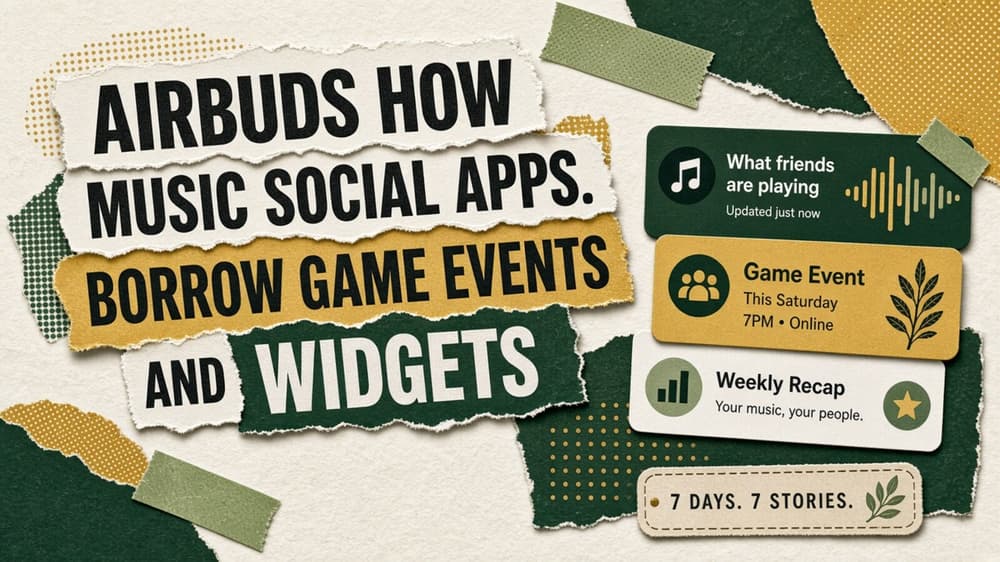
Airbuds stays downstream of Spotify and Apple Music, then wraps listening data in limited-time events and a home-screen widget—the same cadence stack UA teams already know from live-service puzzles.
Music-centric social networks are a graveyard of valiant attempts. Airbuds is interesting against that backdrop not because it invents listening, but because it refuses to. The product sits downstream of Spotify and Apple Music, harvests listening already happening elsewhere, and packages that signal as limited-time social events surfaced through a home-screen widget.
For UA managers and creative strategists, the useful story is not “another Gen-Z app.” It is how a non-game product reuses the event cadence and presence layer that live-service puzzles already treat as retention infrastructure. That archive’s consulting partner Vinayak Sathyamoorthy frames Events as limited-time, interactive experiences that create variety in daily-habit products—staples in billion-dollar titles such as *Royal Match*, *Clash Royale*, and *Monopoly Go*—and argues Airbuds successfully translates that effectiveness into a consumer-app loop.
Scale and funding (company-disclosed via press)
TechCrunch (17 Sep 2025) and the archive report roughly 1.5 million daily and 5 million monthly active users, plus about $10 million in funding from a16z, SV Angel, and Seven Seven Six. Those figures are company-disclosed via press (not a Sensor Tower export); treat them as supported scale/funding claims, still company-asserted rather than audited panel. Relative to Spotify and Apple Music the base is small; relative to prior music-social attempts, rapid growth and stickiness are why capital showed up.
Product position: downstream, not replacement
Earlier music social products asked users to change where or how they listened, or bolted social onto digital music collections. Airbuds keeps the listening habit on incumbent streamers and builds interaction on top. That design choice matters for acquisition creative: the promise is social visibility around taste, not a new catalogue. If your users already do something habitually, build a flywheel on that fuel instead of competing for the same session.
Widget as distribution, not decoration
Airbuds creates lightweight events and passive consumption through widgets. The product asks users to install a widget (iOS and Android) for passive updates without the nag of push. the archive notes the app is officially titled “Airbuds Widget”—store-facing identity leans on the presence surface itself. Spot-check current App Store naming at human review; the operator lesson does not depend on the exact subtitle.
On the home screen, the surface carries ever-changing event highlights—often involving friends—without competing in the push-notification queue. For growth teams, that is a lifecycle channel with different failure modes than push: users opt in by placing real estate; the surface does not go stale in a notification tray; creative can reference presence (“see what friends are playing now”) rather than interrupt.
Operator implication: if your playable or end-card sells a daily habit, ask whether the post-install product has a durable presence layer. Widgets are one form; live tiles, companions, and streak watch-faces are others. The acquisition promise should match a retention surface that still exists after day zero.
Mechanic 1 — Live Moments: manufactured serendipity
Live Moments are events tied to real-time listening activity: what friends are playing now, what they have on repeat, when listening overlaps. They surface continuously, creating ambient awareness without requiring an app open. Design philosophy centres on presence: friends are out there listening right now, and the product makes that visible.
One concrete event is Tune Twins: a notification that fires when you and a friend listen to the same song in a similar time window. The experience starts on the home-screen widget; tap through to a dedicated screen—shared song, both profile photos, a prompt to react. The interaction takes seconds; the emotional payload is coincidence: *we were thinking about the same thing at the same time, without coordinating.*
What makes it work is manufactured serendipity. The moment feels like coincidence; the system is designed to surface overlaps. Without the product, you would never know it happened. the archive compares the pattern to LinkedIn mutual connections or Hinge “you both liked”—revealing hidden connections users already have—with the difference that Tune Twins happens in real time. Urgency and emotional immediacy: you are not learning you had something in common last week; you are learning it while the song is still playing. That immediacy turns information into a moment worth sharing.
Creative map: hooks about simultaneous play or shared moments can be honest without inventing fake social proof in the ad—if the product actually surfaces overlap.
Mechanic 2 — Social Games: quantified relationships
Social Games transform listening data into shareable personality content. They quantify things users feel but cannot articulate—how taste compares to friends, what music says about you—and package answers in screenshot-ready formats. Design philosophy centres on externalization: take an internal intuition and give it a number, a label, a shareable artifact.
Most Compatible Friend calculates which friend you were most musically compatible with (track and genre choices) in a given week. Presented as mystery; tap through to the match. Each friendship becomes quantified, comparable, and critically shareable. Format is built for Stories: clean typography, two names, a large percentage.
It works because it gives users a vocabulary for relationships they already feel. You know which friends share your taste; you rarely have a number. The score externalizes intuition the way Spotify Wrapped does—telling you something you already knew, packaged as discovery—then refreshes regularly so the number can rise or fall. Movement creates stakes around passive behaviour: *we were 84% last week, now 71%—what changed?* Listening becomes a relationship barometer; fluctuation keeps users checking back.
UA angle: mid-funnel retention story and UGC seed. Players already produce shareables if the product grades friendships on a schedule.
Mechanic 3 — Listening Recaps: ritual from passive consumption
Listening Recaps are periodic summaries that package activity into a record worth reviewing. They drop on a predictable schedule—daily or weekly—creating anticipation and ritual. Design philosophy centres on reflection: transform background consumption into something that feels like accumulated effort.
The Weekly Recap, delivered every Sunday in the archive’s teardown, is a Wrapped-style summary: top artists, most-repeated tracks, total minutes, awards such as “#1 Fan” of a specific artist or “Most Minutes Listened” in a friend group. Format is built for sharing—portrait, bold type, stats front and centre—but the deeper function is ritual. Sunday becomes Airbuds day. Expectation, not interruption, pulls the return.
Listening does not feel like an accomplishment while you do it—you are just playing songs. The recap reframes the week as accumulated effort. Same psychology as Strava weekly mileage, Duolingo XP summaries, or Peloton monthly recaps: the summary creates progress the underlying activity does not provide alone. Awards add status even when the threshold is play count. Users begin to care what next week’s recap will say, which subtly shifts listening from background noise to something worth noticing. The recap does not only reflect behaviour; it shapes it.
Games already run weekly league resets and Sunday chests. Airbuds shows the same psychology on music data.
The flywheel as a system
Layered together: continuous micro-awareness (Live Moments), periodic competitive/social stakes (Social Games), weekly reflection (Recaps). Awareness leads to engagement; engagement builds investment; investment drives returns; returns generate shareable content that brings new users. Spotify keeps supplying the fuel.
That multi-cadence stack is the transferable genre insight—whether you ship a puzzle live-ops calendar or a wellness pet. Time-boxed moments, periodic refreshes, and shareable outcomes are not “game-only” mechanics. Airbuds is product-truth evidence they travel when the underlying dataset is strong enough to power them.
Why the three cadences compound
That archive’s useful move is treating Live Moments, Social Games, and Recaps as one system rather than three features. Live Moments keep presence warm; Social Games create periodic stakes; Recaps close the week with identity. Awareness → engagement → investment → return → shareable artifacts → new users. Spotify/Apple Music keep supplying fuel so Airbuds never has to win the listening session itself.
That is the same architecture live-ops calendars use: continuous micro-events, mid-cadence competitions, weekly ritual resets. The dataset differs; the cadence stack does not. For UA, the implication is that creative should declare which cadence it is selling. “Always with friends” without a widget/presence surface is a broken promise. “Sunday identity” without a recap ship date is the same failure mode with nicer typography.
Widget attach as a lifecycle KPI
If the store identity and the retention thesis both lean on the widget, treat widget attach like push opt-in: instrument it, put it in onboarding, and refuse to scale paid until attach clears an internal bar. Presence channels fail quietly—users who never place the widget never see Tune Twins or compatibility movement—so CPI can look fine while Day-7 collapses for the no-attach cohort.
Cross-product note for game teams: any ad that sells “your pet / chest / season is waiting” needs the same attach discipline for whatever presence surface carries that state.
What operators should take into briefs
- Treat existing datasets as foundational. Harvest behaviour already happening elsewhere; do not ask users to relocate the habit first.
- Turn passive behaviour into shareable identity. Numbers users already feel become communicable when you give them a score, a twin, or an award—screenshot-ready.
- Use events to manufacture urgency without spam. Now-or-never moments; the widget carries state so push does not do all the work. Games learned this years ago; consumer apps are catching up.
- Design events at multiple cadences. Live moments for continuous micro-engagement; social games for periodic anticipation; recaps for weekly ritual. Layer so there is always a reason to return—today, this week, and next week.
- Match creative to cadence. Ads that sell “always on with friends” need a live presence surface; ads that sell “Sunday ritual” need a recap the product actually ships.
Airbuds is a case study in Events leaving the games silo—with widgets as a novel distribution mechanism. For Games & Genres work, treat it as evidence that the mechanics UA teams buy against travel. Keep the game-event analogy labelled as analysis, not a claim that Airbuds is a game.
Frequently asked questions
What should a UA operator know about: Airbuds: how music social apps borrow game events and widgets?
Airbuds is useful to UA teams not as another youth social app but as evidence that live-service event cadence and a presence layer travel outside games. The product sits downstream of Spotify and Apple Music, harvests listening already happening elsewhere, and packages that signal as limited-time social events surfaced through a home-screen widget — so acquisition creative should sell social visibility around taste, not a new catalogue. Three mechanics form one system: Live Moments manufacture real-time serendipity (for example overlapping listens with a friend) with urgency while the song is still playing; Social Games externalise intuition into shareable scores and labels that refresh on a schedule; Listening Recaps turn passive consumption into a weekly ritual with identity and status. That stack matches live-ops architecture — continuous micro-events, mid-cadence stakes, weekly resets — and creative should declare which cadence it is selling: "always with friends" without a widget or presence surface is a broken promise, and "Sunday identity" without a recap the product ships is the same failure with nicer typography. Treat widget attach like push opt-in: instrument it, put it in onboarding, and refuse to scale paid until attach clears an internal bar, because presence channels fail quietly and CPI can look fine while retention collapses for the no-attach cohort. Operator brief takeaways: harvest existing datasets rather than relocating the habit; turn passive behaviour into screenshot-ready identity; use events for urgency while the widget carries state; design multiple cadences so there is always a reason to return today, this week and next week; match creative to the cadence the product actually supports. Keep the game-event analogy as analysis, not a claim that Airbuds is a game.
Related posts
market intelligence
media buying
·1 min read
Lunar New Year UA gates from an official calendar, not a CPI myth
market intelligence
media buying
·2 min read
WeChat Mini Games upgrades 2026 IAP / virtual-payment incentives for debut titles
market intelligence
media buying
·2 min read