First-purchase offer matrix: price, soft currency, and eligibility windows
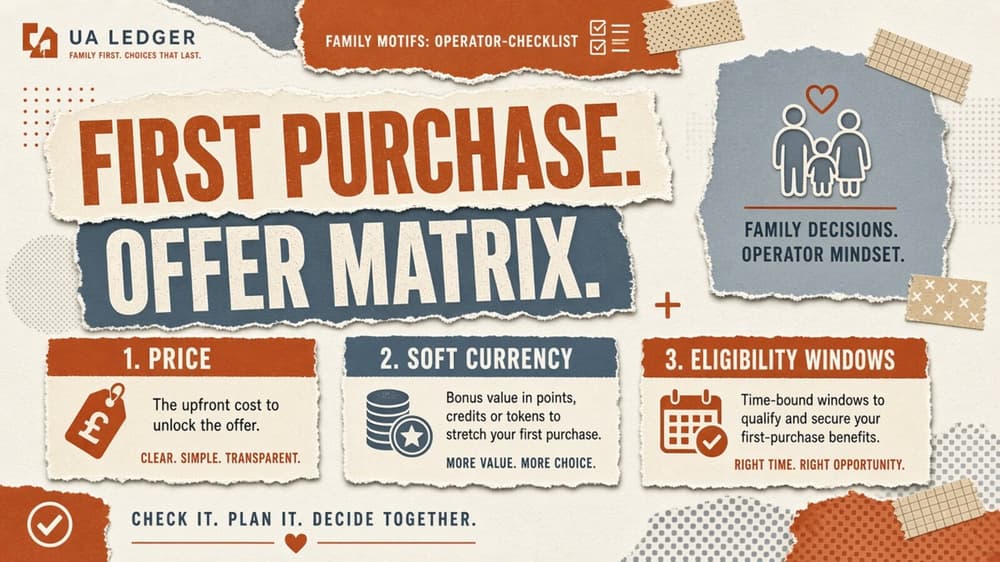
Reusable first-purchase matrix gated on App Store price points and Play promo/IAP rules — not a genre price essay.
First-purchase packs still drive early ROAS only when price, soft-currency grant and eligibility window are the same object in store, client and ads. Build a matrix; do not improvise per geo in Slack.
Documented store constraints
Apple’s Set a price for an In-App Purchase (source read 20 September 2026) requires choosing from up to 800 price points, with a base country or region used to generate comparable prices across 174 storefronts. Hard-coding a single USD tier into every locale without a price schedule will break when Apple equalises non-base storefronts.
Google Play promo codes document one-time-use and custom codes, quarterly creation limits (including 500 one-time-product codes per quarter per app) and redemption in-app or in Play Store. Promo codes are not a substitute for a priced starter SKU; they are a separate eligibility path.
Matrix fields (operator checklist)
- SKU / product ID — one row per store and platform.
- List price point — App Store price point ID or Play purchase-option price; never a free-text “about $5”.
- Soft-currency grant — exact amount and currency ID shown in FTUE and in ads.
- Eligibility window — hours since install, or “never purchased”; document whether reinstalls reset it.
- Promo-code path — if used, record code type, end date and whether ads mention it.
- Creative claim QA — endcard price and grant must match the live matrix row.
Facts vs limits
| Fact | Limit |
|---|---|
| Apple documents price-point and storefront equalisation behaviour | This checklist invents no observed starter-pack price |
| Play documents promo-code types and quarterly caps | Soft-currency economy design is studio-specific |
| StoreKit is the IAP surface on Apple | Web-shop first-purchase paths are out of scope here |