Puzzles & Survival: turn a narrative-plus-gameplay result into a factorial brief
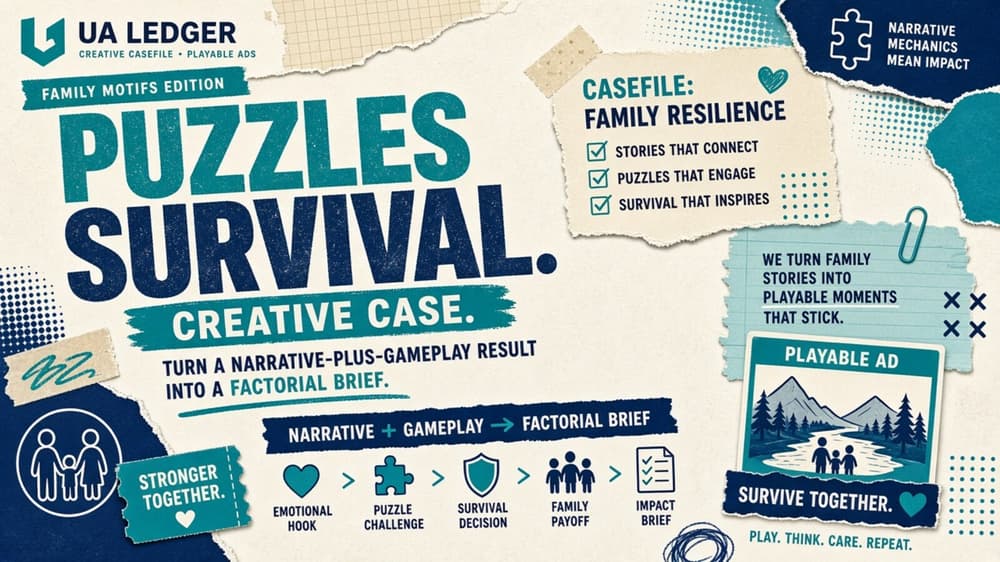
Liftoff's Puzzles & Survival case names two creative dimensions: visual treatment and narrative emphasis. They should remain separate decisions when another team tries to learn from the example.
Liftoff's Puzzles & Survival case names two creative dimensions: visual treatment and narrative emphasis. They should remain separate decisions when another team tries to learn from the example.
What the public case establishes
Liftoff says it tested two-dimensional versus three-dimensional graphics and UI-focused versus story-focused ads for 37GAMES' Puzzles & Survival. It reports that narrative material retaining core gameplay performed best, alongside a revenue-focused optimisation model. Those are the advertising supplier's findings, not an experiment we independently reproduced. Liftoff case study.
This is a source-led creative casefile, not a frame-by-frame viewing or a campaign we ran. The diagram below is our own schematic. It does not reproduce the advertiser’s footage, and we have not established reuse permission for that footage.
The decision worth examining
The obvious imitation is a three-dimensional story ad. The better learning opportunity is a small matrix that asks whether the effect belongs to rendering, explanation or their combination. A more expensive visual treatment may help readability, signal production quality or simply correlate with a better-written concept. Copying the final package without keeping the dimensions distinct prevents a useful cost decision.
Build a two-by-two brief with narrative emphasis and visual treatment as the axes, using the same product action and end card. This is a proposed experiment, not a claim that the original case used this exact factorial design. Every cell needs comparable execution quality; a rushed control makes a polished variant's apparent advantage uninformative.
A usable next check
Before media delivery, review the four cells for equal rule clarity and production completeness. Cost them separately so the team can judge whether an improvement would justify the more demanding treatment. In a campaign test, use one value definition and document allocation. If the model or audience changes while cells run, report that change as a limit rather than crediting the art style.
| Test element | Proposed specification |
|---|---|
| Control | UI-led and story-led executions using one visual treatment |
| Variant | Matched executions using the alternative visual treatment |
| Readout | Rule clarity, production cost and value by declared test cell |
| Stop or reject | Reject a verdict based on unequal polish or a changing optimisation model |
Download the populated case worksheet. Its control, variant and decision rules are a proposed experiment, not an account of results already measured. Keep the source URL with the worksheet when circulating it so reported findings cannot become unattributed team benchmarks.
Evidence boundary
The vendor source gives selected outcomes without releasing assignments, spend or raw cohorts. We did not inspect its original ad files. The visual map represents our proposed two-factor learning design and carries no campaign performance forecast.
For background, see the creative brief is a hypothesis document and post campaign creative debrief process. No first-hand campaign result is asserted.