King's Throne: an influence-channel result still needs an asset-level explanation
GOAT Games' King's Throne case describes a route into iOS acquisition. It leaves an important creative question open: what did the audience actually see, and which promise carried into the game?
GOAT Games' King's Throne case describes a route into iOS acquisition. It leaves an important creative question open: what did the audience actually see, and which promise carried into the game?
What the public case establishes
Liftoff's GOAT Games account says the advertiser had focused on Android because iOS acquisition economics were unattractive in its earlier tests. It credits Liftoff Influence with making iOS acquisition viable for King's Throne: Game of Lust. The public account provides a channel-level story, not a detailed creative comparison. Liftoff case study.
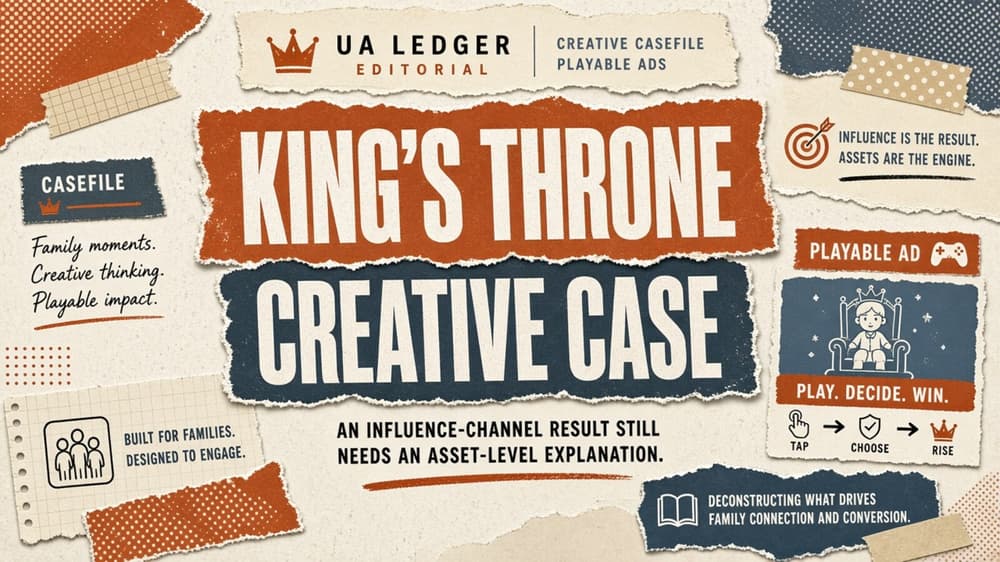
This is a source-led creative casefile, not a frame-by-frame viewing or a campaign we ran. The diagram below is our own schematic. It does not reproduce the advertiser’s footage, and we have not established reuse permission for that footage.
The decision worth examining
A new distribution route can change audience composition, endorsement context and the way a video is encountered. Those differences make a channel result difficult to translate into a production brief. Requesting more influencer-style ads is not specific enough: a team needs to know the actual product claim, the presenter relationship and the transition from entertainment to the install destination.
The case map deliberately contains an evidence gap rather than invented frames. It asks for an authorised asset, its placement context and the game moment supporting its promise. If those inputs cannot be supplied, keep the case at channel level. The absence of a visible creative object is a reason to narrow the conclusion, not to fabricate a likely hook.
A usable next check
For a future rights-cleared influence execution, preserve one example with the original context and one adaptation for a controlled placement. Before any paid comparison, check that both communicate the same eligible product experience and that endorsements are appropriately disclosed. Evaluate differences in expectation as well as attention; a borrowed presenter relationship may not survive a repurposed edit.
| Test element | Proposed specification |
|---|---|
| Control | Authorised execution in its original disclosed placement context |
| Variant | The same product promise adapted to a controlled placement |
| Readout | Promise comprehension and audience-context differences |
| Stop or reject | No creative-performance claim without identified assets and comparable delivery |
Download the populated case worksheet. Its control, variant and decision rules are a proposed experiment, not an account of results already measured. Keep the source URL with the worksheet when circulating it so reported findings cannot become unattributed team benchmarks.
Evidence boundary
The case's acquisition and growth claims remain supplier-reported. We did not view a campaign video, verify app-store rankings or inspect the underlying cohorts. No audience or creative result has been inferred from the channel narrative.
For background, see the creative brief is a hypothesis document and post campaign creative debrief process. No first-hand campaign result is asserted.