Attack Hole: audit semantic variety before counting localisation exports
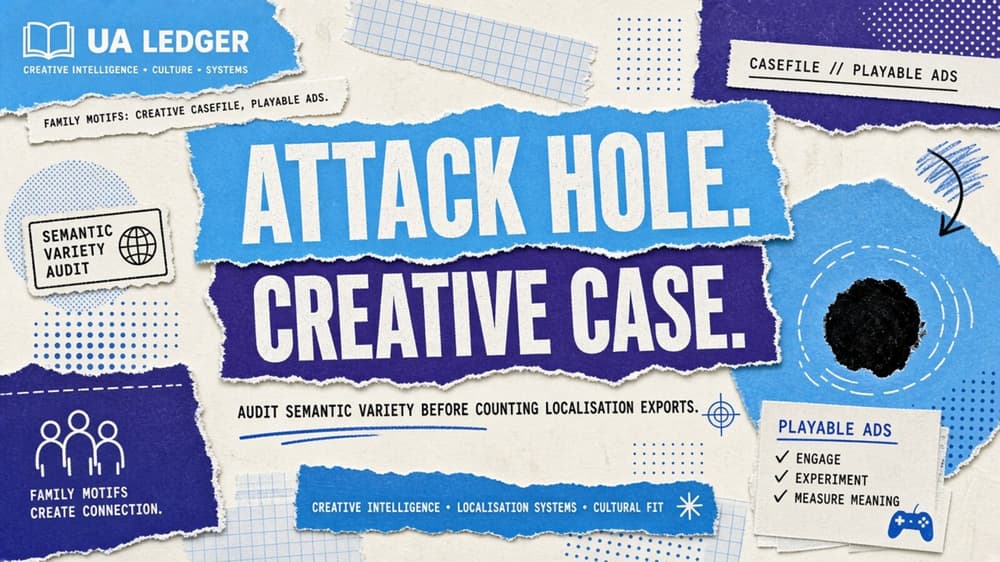
HOMA's Attack Hole case makes creative volume visible, but a production team still needs to distinguish a new idea from another language or delivery of the same idea.
HOMA's Attack Hole case makes creative volume visible, but a production team still needs to distinguish a new idea from another language or delivery of the same idea.
What the public case establishes
TikTok reports HOMA producing a large gameplay-led creative pool for Attack Hole, using text-to-speech and multiple languages, then adding creator-generated material. The campaign moved from install acquisition towards value optimisation across many markets. The public page describes the game as controlling a hole that consumes objects and attacks enemies. TikTok for Business case study.
This is a source-led creative casefile, not a frame-by-frame viewing or a campaign we ran. The diagram below is our own schematic. It does not reproduce the advertiser’s footage, and we have not established reuse permission for that footage.
The decision worth examining
Counting exports can make a portfolio look more diverse than the hypotheses inside it. A translated voiceover is operationally useful, but it may preserve exactly the same promise, action and reveal. A creator reaction can add a new point of view while leaving the underlying game argument unchanged. The team should count both production outputs and semantic differences, without pretending they measure the same thing.
Our proposed taxonomy uses three keys: the player problem, the demonstrated action and the payoff shown. Language and delivery style remain additional fields. Two videos sharing all three keys are variations of one concept even if they have different actors or file names. That taxonomy is an original working aid; the source does not publish HOMA's own internal naming system.
A usable next check
Take a rights-cleared batch and classify it before looking at performance. Have a strategist and a producer code a sample independently, reconcile disagreements, and freeze the definitions. Only then compare results by concept family and localisation. If a family has many exports but little delivered exposure, distinguish an inventory surplus from actual audience saturation.
| Test element | Proposed specification |
|---|---|
| Control | Portfolio counted by exported files |
| Variant | Same files also grouped by promise, action and payoff |
| Readout | Concept coverage, coding agreement and delivered exposure per family |
| Stop or reject | Do not label language variants independent concepts without a changed hypothesis |
Download the populated case worksheet. Its control, variant and decision rules are a proposed experiment, not an account of results already measured. Keep the source URL with the worksheet when circulating it so reported findings cannot become unattributed team benchmarks.
Evidence boundary
We did not inspect HOMA's original files or reproduce the vendor's campaign totals. The source cannot establish how many fundamentally different concepts existed or the independent effect of the creator expansion.
For background, see the creative brief is a hypothesis document and post campaign creative debrief process. No first-hand campaign result is asserted.