Daily missions in puzzles: make the appointment explicit
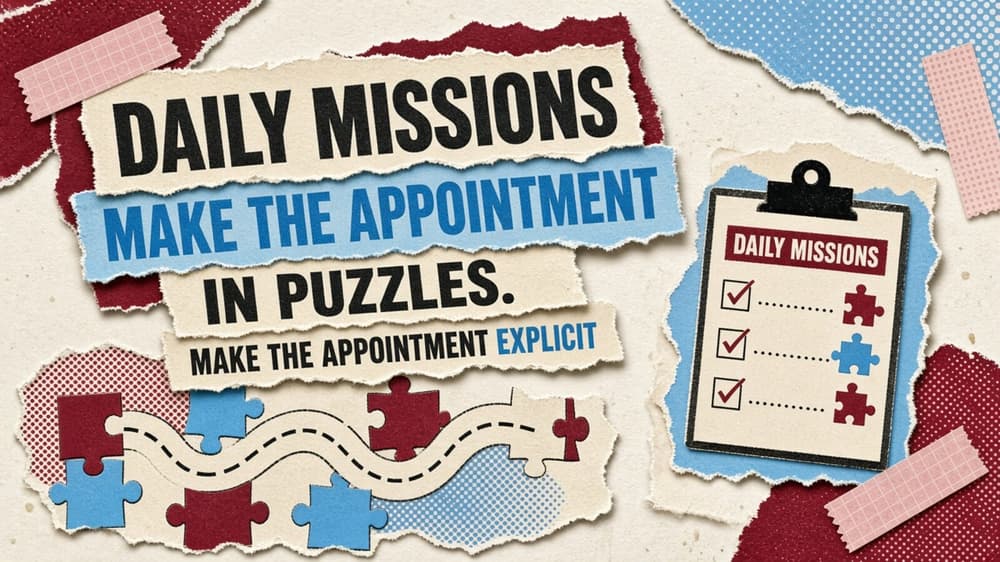
Full-depth archive rewrite on explicit daily missions for puzzle games.
Ahmetcan Demirel on prior industry analysis (archive date 2024-09-23— archive editorial timing, not UA Ledger first-live) makes the case that puzzle games already run mission logic under other names — and should surface explicit daily missions as a first-class appointment surface, the way mid-core and action titles already do.
Puzzles are already using missions—just not explicitly
For many puzzle games, the closest implementation of daily missions has been the use of daily login gifts. These rewards are presented to players simply for opening the game each day, offering small incentives such as in-game currency, boosters, or extra lives. This approach is widely used because it serves as a basic appointment mechanic, encouraging players to maintain a routine of checking in with the game regularly.
While daily login gifts are effective in promoting retention by nudging players to open the game, they fall short in terms of meaningful engagement. Unlike daily missions, which require players to actively participate in gameplay, these gifts offer rewards with no gameplay involvement—merely logging in is enough. This can lead to a superficial interaction where players are not required to interact with the game, missing out on the deeper engagement that could be fostered through gameplay-driven daily missions.
Homescapes and its daily gift system that is quite similar to many other puzzle games.
However, puzzle games are no strangers to missions, even if they don’t always label them as such. Take Toy Blast, for example. The game incorporates daily missions through its “Hoop Shot” event, where players complete straightforward tasks in exchange for rewards. Players are given multiple paths to follow to earn their rewards, adding a layer of gamification to the missions. Essentially, there are four different options available for each mission, and players can switch between them at any time, allowing for a more personalized and strategic approach to completing tasks..
Candy Crush Saga is another example of a similar mission structure. The "Classic Chocolate Box" event, which is run regularly, presents players with four missions that must be completed sequentially to unlock rewards. This format encourages continuous engagement, as players must progress through each mission in order to reach their final prize, creating a sense of anticipation and achievement as they advance. Candy Crush Saga’s Classic Chocolate Box event doesn’t have branching paths like Toy Blast’s Hoop Shot, but it does let players swap their current mission up to three times. Players can also see the rewards before choosing, which can impact their decision and cater to different player preferences.
Toy Blast (left) giving all the options at once while Candy Crush Saga (right) asking you to go one step at a time.
Some games take it further by integrating missions into team-based events or collaborative efforts, which adds a community element to mission completion. For instance, Project Makeover features weekly team missions. Each week, teams receive a mission with specific milestones that players contribute to. This can create peer pressure, as individual contributions are visible, potentially leading to tense moments in highly competitive teams.
Seeing yourself and your teammates alongside everyone’s contribution is surely there to put you under pressure…
Then there’s Toon Blast, incorporating a mission-like mechanic with its mini-season pass system, where players advance by completing various objectives. It is a relatively new feature that the archive suggests is likely to be adopted by other games soon. Season passes are common across many games, so introducing a simplified version could be effective. For players who haven't invested in a full season pass, offering a short-term deal with straightforward tasks could be a compelling alternative.
These features, while engaging, are scattered across different game elements, rather than being streamlined into a dedicated daily mission system. They are often time-limited challenges that ask players to clear a certain number of levels or collect specific items. These types of missions encourage continued play but lack a centralized, daily mission structure. And we’re starting to see puzzle games implement daily missions in a more structured and explicit manner.…
The case for explicit daily missions in puzzle games
A standout example of a puzzle game that has recognized the power of missions is Royal Match. Their approach includes features like “Mission Pursuit” and “Mission Control,” though the missions aren't daily. These missions are front and center, offering players a specific goal to achieve such as completing a certain number of levels on first try or collecting a certain amount of in-game currency. It is still given as a time limited event, but the rotating events make it an almost permanent part of the player’s life.
In its essence, there is not much difference between Royal Match and other games mentioned above, but being explicit about missions and calling them such helps shorten the funnel for players to see them. As we are talking about games on mobile devices, fewer taps needed to access features often means greater impact.
Royal Match has two rotating mission events at the moment. Curious to see if there will be more or if one will be eliminated some time…
Newer puzzle games like Time Blast have embraced this trend from the start by making daily missions a core feature. The clear presentation and dedicated space for daily missions, separate from time-limited events, is particularly noteworthy. It demonstrates that daily missions were not merely an afterthought added to boost engagement. Instead, they are a core component of the game, available from the outset.
As we covered in a previous article, combining daily missions with a daily deal can amplify the impact of this appointment mechanic. Encouraging players to regularly engage with different aspects of the game while visiting the shop daily can create a strong synergy. When these appointment mechanics are clearly presented and not tied to time-limited events, it becomes even more seamless for players to interact with them. So, having daily missions presented explicitly isn’t just beneficial on its own merits, but also brings other potential advantages.
Why Puzzle Games Should Adopt Explicit Daily Missions
As puzzle games continue to evolve, incorporating explicit daily missions is an opportunity worth exploring. While some games like Royal Match and Time Blast are already experimenting with mission-based systems, there is still a significant untapped potential in making daily missions a more central and explicit feature. Here are some of the reasons why puzzle games should consider integrating daily missions more explicitly:
Enhanced engagement over daily login gifts: Daily login gifts are the closest puzzle games have come to utilizing daily missions, but they fall short in terms of meaningful player interaction. Players simply log in, claim their reward, and often exit without further engagement.
Daily missions could shift the focus from passive interaction to active gameplay. For example, instead of receiving a booster just for logging in, players could be rewarded for completing specific tasks, such as clearing a set number of levels using that booster. This would not only incentivize players to stay longer but also foster a stronger connection to the game.
Improved onboarding: Onboarding new players can be a challenge, especially when it comes to introducing power-ups and boosters. Many players hesitate to use these tools, either because they don’t fully understand them or they prefer to save them.
Daily missions could be designed to encourage early experimentation with power-ups and boosters. Missions could require players to use a specific booster in various levels, helping them to see its effects and benefits firsthand. This hands-on approach would build player confidence and enhance their understanding of the game mechanics, leading to a more satisfying gameplay experience.
Better reasons for push notifications: Push notifications are a key tool for re-engaging players, but they need to offer real value to be effective. Instead of sending generic reminders to log in and claim a daily gift, notifications could inform players about new daily missions. For instance, a notification could say, “Complete today’s mission for double rewards!”. This type of notification provides a clear reason to play, encouraging not just a login, but active participation in the game.
It’s clear that directly copying a feature from another game isn’t the most effective way to draw inspiration. This is especially true when the feature is uncommon in your genre, forcing you to look at games with entirely different audiences. While adapting daily missions into a puzzle game may require extra effort and involve certain opportunity costs, I believe it’s still worth the investment. Successful puzzle games can benefit from integrating daily missions in a more explicit and structured way.
As mentioned earlier, we’re already seeing early signs of this shift, and the archive suggests this is just the start. While larger games are generally resistant to change, we've seen how quickly they adapt once a new feature proves successful in the market. If daily mission structures show clear benefits in boosting engagement and performance, we can expect more games to experiment with them, and others will likely follow suit.
Archive mechanisms — depth expansion (operator paraphrase)
The following deepens under-covered archive mechanisms in Games & Genres language. Figures remain archive-reported secondary from the archive window unless a primary panel is attached later. This pass adds product-truth substance—not filler padding.
Puzzles are already using missions—just not explicitly
That archive’s “Puzzles are already using missions—just not explicitly” block is restated here as systems brief for UA and live-ops. We paraphrase how the product worked in the archive window and what that implies for creative, CRM, and measurement.
Then there’s Toon Blast, incorporating a mission-like mechanic with its mini-season pass system, where players advance by completing various objectives. It is a relatively new feature that the archive’s framing is that is likely to be adopted by other games soon. Season passes are common across many games, so introducing a simplified version could be effective. For players who haven't invested in a full season pass, offering a short-term deal with straightforward tasks could be a compelling alternative.
These features, while engaging, are scattered across different game elements, rather than being streamlined into a dedicated daily mission system. They are often time-limited challenges that ask players to clear a certain number of levels or collect specific items. These types of missions encourage continued play but lack a centralized, daily mission structure. And operators’re starting to see puzzle games implement daily missions in a more structured and explicit manner.…
UA implication — Puzzles are already using missions—just not explicitly: Keep every dollar, rank, and retention figure in this block labelled archive-secondary until Fact Checker attaches period/geo/methodology. Steal the diagnostic questions; do not steal vintage chart swagger as 2020s market colour.
Evidence posture
Archive date is archive editorial timing, not UA Ledger first-live. Feature timings, competitive “three months later” observations, and design descriptions are secondary teardowns — spot-check live clients at human review. No fabricated lift percentages. No publish.
Operator synthesis
Replace passive login gifts with gameplay tasks; use missions to teach boosters; write push copy around mission value; instrument completion and D7. Cross-link Time Blast and win-streak essays.
Related posts
market intelligence
media buying
·1 min read
Lunar New Year UA gates from an official calendar, not a CPI myth
market intelligence
media buying
·2 min read
WeChat Mini Games upgrades 2026 IAP / virtual-payment incentives for debut titles
market intelligence
media buying
·2 min read