Finch: gamified widgets as a retention surface when CPI is expensive
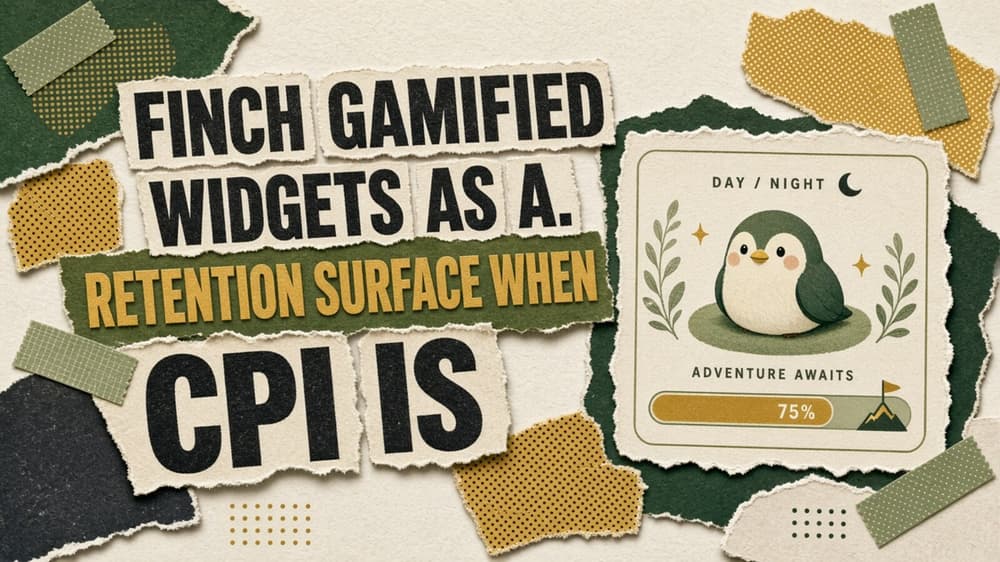
Wellness app Finch turns a virtual pet into always-on home-screen presence—appointment states, progress bars, and daily-rhythm micro-events that UA teams should treat as post-install infrastructure, not UI garnish.
When paid CPI sits in the high teens or twenties, Week-1 retention is not a soft KPI—it is whether the media buy survives. Finch, a mental-wellness app built around self-care tasks that feed a virtual pet, makes that economics problem visible through an under-used OS surface: the home-screen widget. That archive’s Vinayak Sathyamoorthy frames Finch’s widget as a first-class re-engagement channel alongside email, push, and SMS. For Games & Genres analysts, the pattern is familiar: presence and appointment mechanics, ported out of games into a consumer habit product.
Scale claims (archive-reported — hedges must stay)
the archive states Finch was founded in May 2021, cites an estimated 10 million monthly active users, and quotes D1/D7 retention of 54%/37%, with comparison figures for Duolingo (51%/35%) and Royal Match (40%/25%), credited to Sensor Tower via Sam Aune. Those retention and MAU numbers are not independently verified in this backfill. Verdict for publication: unresolved until Fact Checker pulls the underlying Sensor Tower cut (period, geo, platform, methodology). Do not promote them to Ledger fact on the archive restatement alone.
Core loop the widget must serve
Users complete daily mental-health tasks—mood tracking, journaling, goal completion—to earn energy, cosmetics, and progression for the pet. Loop in product-truth terms: self-care actions → rewards (energy, outfits, room décor) → progress (evolve pet, unlock areas, complete adventures).
Widgets are persistent real estate on the home screen. When users check their phones every few minutes, widgets can provide passive value without urgency to jump in. Unlike push notifications, they do not get pushed down a queue or go stale from disuse. That is why the archive puts them on the same playing field as email, push, and SMS as a re-engagement channel—complementary, not a replacement.
The widget only works if it mirrors the loop’s live state. A static brand tile teaches nothing; a living pet that changes when tasks complete teaches the economy the ad promised.
Widget mechanic 1 — Living pet presence
The Finch widget is a window into the pet’s life. Design philosophy centres on presence: the pet experiences a life while you are away—adventures during the day, sleep at night. That archive’s analogy: a live feed of a pet at home while you are at work; the creature is not frozen between sessions.
Customization is embedded in the product and reflected on the widget: clothing, accessories, room décor, environment. When the pet evolves or seasons change, widget appearance changes. That is not garnish. It creates emotional investment and a stronger desire to maintain the relationship with the pet—and by extension the app. Presence beats prompting.
Widget mechanic 2 — Appointment states for Adventuring
Appointment mechanics are a staple re-engagement pattern in games: Clash Royale chest timers; Wordle’s daily puzzle. Finch creates an appointment with Adventuring: complete enough self-care tasks for the day, and the pet starts a timer-gated adventure.
The widget maximises impact: an In Progress state shows the pet occupied during long daytime stretches; a Completed state encourages return for rewards. Organic return windows without stacking push. Games put timers inside the client; Finch puts the timer on the home screen where attention already lives.
Widget mechanic 3 — Progress bar toward the day’s objective
One clear progress bar keeps focus on completing enough self-care tasks daily. Non-forceful, simple: finish the day’s tasks. The goal is getting the pet to Adventuring. Completing the bar triggers the adventure cycle, creating a direct connection between user actions and pet activity.
The bar turns abstract self-care into concrete visual movement toward a reward users care about. For creative strategists: end-cards that sell “complete your day” should match a visible progress object post-install—otherwise the ad oversells clarity the product does not surface. Keep it one clear bar, not multiple competing metrics.
Widget mechanic 4 — Micro-events on daily rhythm
Morning check-ins encourage completing Finch tasks and protecting streaks. Design pushes users to finish enough tasks in the first half of the day so they can check back by evening for a “Chat” after a multi-hour adventure (prior industry analysis cites a roughly six-hour adventure window). The reward is seeing what the pet discovered.
Friend visits add random surprise bonuses without becoming the core loop. This is anti-nag design: event-driven hooks at natural day transitions—curiosity, not constant interruption. The widget shows these moments passively; users check when curious, not when interrupted.
Takeaways operators can map
- Design for continuous value, not snapshots. Find elements of the product with continuous, live, or evolving state—then surface that in the widget. Weather widgets evolve; Airbuds surfaces what friends listen to now; Finch’s pet creates an “always with you” feeling.
- Let the widget communicate the appointment. Timer-gated rewards and daily refreshes only work if the appointment is visible throughout the day without constant notifications.
- Use progress bars to create clear visual objectives. Complete X, unlock Y. Bridge daily tasks to a reward users care about.
- Map micro-events to daily rhythm, not constant nudges. Morning check-in, evening reflection; mix core anchors (streaks) with surprise bonuses (friend visits).
Implications for UA and lifecycle
That archive’s closing economic line—compete when acquisition costs are $20+ per install—should be read as market colour, not a Finch-specific CPI audit. Keep that framing. The transferable lesson is channel mix: widgets do not replace push; they occupy attention users already give the home screen. Creative that sells “your pet is waiting” only converts if install → widget adoption is instrumented. Measure widget attach rate as seriously as push opt-in.
For hybrid-casual and mid-core teams, ask which live states deserve permanent real estate: chest timers, season-pass progress, alliance help requests, energy regen. If the answer is “none,” the product may be asking paid UA to recreate urgency that presence could carry more cheaply.
Mapping Finch to game presence surfaces
That archive’s four mechanics map cleanly onto live-game systems UA already buys against:
| Finch widget | Game analogue | UA/creative note |
|---|---|---|
| Living pet presence | Companion/pet state, seasonal skins | Sell continuity, not a frozen mascot |
| Adventuring In Progress/Complete | Chest timers, build queues | Appointment must be visible without push |
| Daily progress bar | Daily quest / energy-to-goal meters | End-card “complete your day” needs a real bar post-install |
| Morning/evening micro-events | Streak shields, evening claim windows | Cadence creative ≠ interrupt creative |
The point is not that Finch is a game. It is that expensive CPI environments punish products that only interrupt and never *reside*. Widgets (and equivalents) are how residence shows up on modern OS home screens.
Retention hedges stay visible
Until Fact Checker lands a Sensor Tower (or equivalent) cut with period, geo, platform, and methodology, keep ~10M MAU and D1/D7 54%/37% vs Duolingo 51%/35% and Royal Match 40%/25% labelled archive-reported / unresolved. The widget teardown can still inform creative and lifecycle briefs; the benchmarks cannot yet be Ledger facts. CPI “$20+” remains market colour, not a Finch CPI audit.
Soft-launch checklist for widget-led retention
Before scaling paid spend against a “pet is waiting” promise, instrument three events: widget install/attach, first adventure start, and first adventure complete. If attach stays low, fix onboarding placement before buying more traffic. If attach is healthy but adventure completion is not, the appointment mechanic is invisible or too slow—the widget cannot salvage a broken day loop. Games shipping energy, chests, or daily quests can run the same checklist against their own presence surfaces.
Finch is not a game, but its retention surface is game-native. That is the genre insight worth stealing carefully—and verifying before anyone quotes the retention benchmarks as Ledger fact. Keep the MAU and D1/D7-versus-comps hedges visible until primary intel lands.
Frequently asked questions
What should a UA operator know about: Finch: gamified widgets as a retention surface when CPI is expensive?
When paid CPI sits in the high teens or twenties, Week-1 retention is whether the media buy survives. Finch, a mental-wellness app built around self-care tasks that feed a virtual pet, treats the home-screen widget as a first-class re-engagement channel alongside email, push and SMS — presence and appointment mechanics ported out of games into a consumer habit product. Archive-reported scale claims — founded May 2021, estimated 10 million monthly active users, D1/D7 retention of 54%/37% versus Duolingo 51%/35% and Royal Match 40%/25% (Sensor Tower via Sam Aune in the archive) — remain archive-sourced colour only; treat them as unresolved without a primary cut that states period, geo, platform and methodology, and do not promote them to Ledger fact on the restatement alone. The product loop is self-care actions → rewards (energy, outfits, décor) → progress (evolve pet, unlock areas, adventures); the widget only works if it mirrors that live state rather than sitting as a static brand tile. Four mechanics transfer: living pet presence (the creature has a life between sessions); appointment states for Adventuring (In Progress / Completed visible without stacking push); one clear daily progress bar tying tasks to a reward users care about; and micro-events on daily rhythm (morning check-in, evening chat after a multi-hour adventure, friend-visit surprises) rather than constant nudges. Map those onto game presence surfaces — companion state, chest timers, daily-quest meters, streak shields — and ask which live states deserve permanent home-screen real estate; if the answer is none, the product may be asking paid UA to recreate urgency that presence could carry more cheaply. Creative that sells "your pet is waiting" only converts if install → widget adoption is instrumented; measure widget attach rate as seriously as push opt-in. Before scaling paid spend against that promise, instrument widget install/attach, first adventure start and first adventure complete — low attach means fix onboarding placement before buying more traffic. CPI "$20+" in the archive closing line is market colour, not a Finch CPI audit.
Related posts

market intelligence
media buying
·1 min read
Lunar New Year UA gates from an official calendar, not a CPI myth

market intelligence
media buying
·2 min read
WeChat Mini Games upgrades 2026 IAP / virtual-payment incentives for debut titles
market intelligence
media buying
·2 min read