Merge games and the hybrid-casual UA template
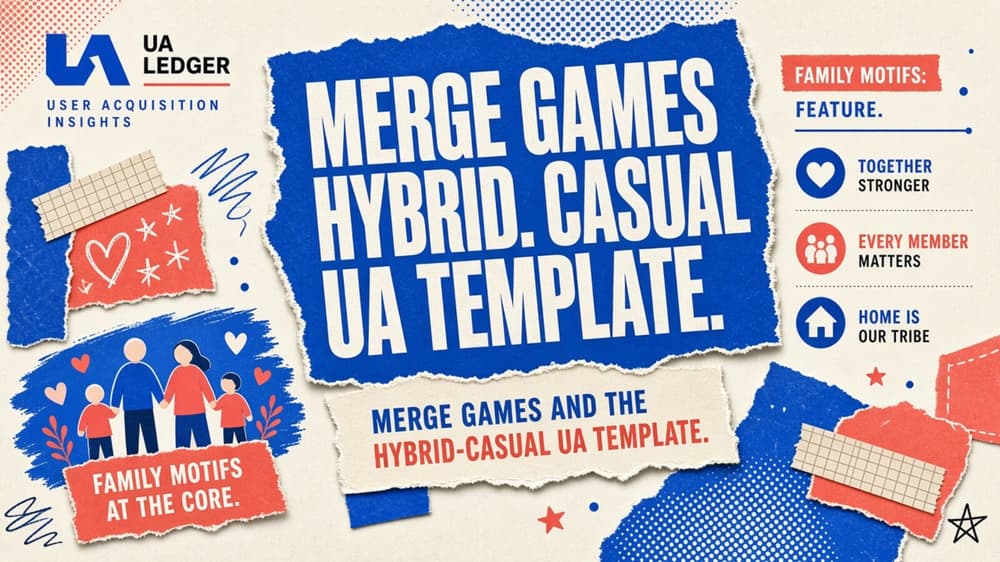
Merge became the model for hybrid-casual UA because its loop is legible to bidding algorithms, not because it is the best mechanic. That matters now.
The merge genre did not become the reference model for hybrid-casual acquisition because merging is the most compelling mechanic in casual gaming. It became the model because its loop reads unusually clearly to the algorithms that now decide who sees an ad at all. Merge throws off clean behavioural signals early and repeatedly, and automated bidding systems reward advertisers whose users behave predictably in the first forty-eight hours. The buying infrastructure picked the mechanic. Players did not.
If that is right, it carries an awkward implication: the template built on merge fits the way networks learned in the early 2020s, and the studios copying it today inherit the constraints along with the results.
What the algorithms actually see
Hybrid-casual monetisation sends two kinds of conversion event back to the networks: ad engagement and in-app purchase. A merge loop generates both quickly. Players hit the board's first bottleneck within a handful of sessions, which triggers a rewarded ad or a small purchase, and they do it in a pattern that varies little from person to person. The event stream is dense and consistent.
Networks optimising towards purchase, or towards a predicted revenue value, want exactly this. AppsFlyer's State of Gaming for Marketers 2026, published in January, recorded paid install share rising year on year and ad impressions up by a fifth. More of the market's growth runs through automated bidding now, and automated bidding learns fastest from games whose early events arrive on schedule.
A deeper strategy game, or a narrative title whose value emerges over weeks, produces the same eventual revenue from a sparse, late, irregular event stream. The network's model has less to work with and bids less confidently. Merge, by accident of design, speaks the model's language.
The template that came out of it
The acquisition playbook that grew around merge titles has four moving parts, and most hybrid-casual launches since have copied it whether or not the underlying game suits it:
- A mechanic-first hook in the opening two seconds, usually a hand dragging two items together.
- A visible fail state or blocked board, to imply challenge.
- A meta reveal: the garden, the mansion, the town that the merging pays for.
- An event or timer to suggest urgency.
This desk wrote about the craft side in Writing Hybrid-Casual Creative Hooks That Still Convert, and the hooks still work.
The point here is structural. A template is a way of packaging a game so that it throws off the early signals the network wants, which means it works best on games that would have thrown off those signals anyway.
The convergence problem
Now the second-order effect. When every hybrid-casual title adopts the same acquisition template, they are all buying the same person with the same argument. The bidding systems see near-identical creative from a dozen advertisers and have to rank it somehow, so the tiebreaker becomes bid rather than concept. The template's success drives up its own cost.
There is a creative side to this too: a feed full of near-identical drag-and-merge hooks trains players to scroll past them. The genre's creative fatigue belongs to the category rather than to any one campaign, and no single studio fixes it by refreshing its own variants faster.
The supply side is consolidating at the same time. Unity's closure of the ironSource Ads network on April 30 removed one of the demand sources many hybrid-casual publishers had grown up with, and pushed spend toward the remaining large platforms whose models all reward the same legibility. Fewer auctions, more advertisers following the same template, a shared audience: that is the shape of a margin squeeze.
A decision rule for whether the template fits
Before adopting the merge-derived template, a team should ask whether its own game produces the signals the template assumes. Three measurements settle it, with invented figures purely to show the shape.
Start with the median time to first monetisation event in the soft launch cohort: under two days and the template fits. A week or more and the template will attract the wrong player while the network learns from the wrong events. Then measure the variance in that timing across users, because low variance is what networks like. High variance, where some players convert in an hour and others in a month, means the network's prediction will be mediocre no matter how good the creative is. Last, count how many distinct early events the game can honestly send; a game with one meaningful early signal should not pretend to have four.
A game that fails two of these three is not a hybrid-casual game in the acquisition sense, whatever its monetisation model looks like. Buy it as a mid-core title: longer optimisation windows, value-based bidding with patient targets, creative that sells the depth rather than the drag.
Where merge goes from here
The merge genre itself is mature. Sensor Tower's State of Gaming report in February credited puzzle and strategy with leading the year's growth, and merge sits inside puzzle as an established rather than expanding sub-genre. Its UA template, though, still gets copied by games that have nothing in common with it beyond a hybrid monetisation stack.
The useful distinction for a buyer separates the template as a creative style from the template as a signal architecture. The creative style is a fashion and will pass. The signal architecture, the idea that a game should produce early, consistent, honest conversion events that automated bidders can learn from, is the durable part, and it applies well beyond merge.
Teams that understand which part they are copying make better decisions when the template stops working, which for a growing share of the category it already has. The rest keep refreshing hooks and wondering why the cost per install rises each quarter regardless.
Related archive reading
Related posts
market intelligence
media buying
·1 min read
Lunar New Year UA gates from an official calendar, not a CPI myth
market intelligence
media buying
·2 min read
WeChat Mini Games upgrades 2026 IAP / virtual-payment incentives for debut titles
market intelligence
media buying
·2 min read