MobilityWare: splitting UA and creative still requires a shared acceptance contract
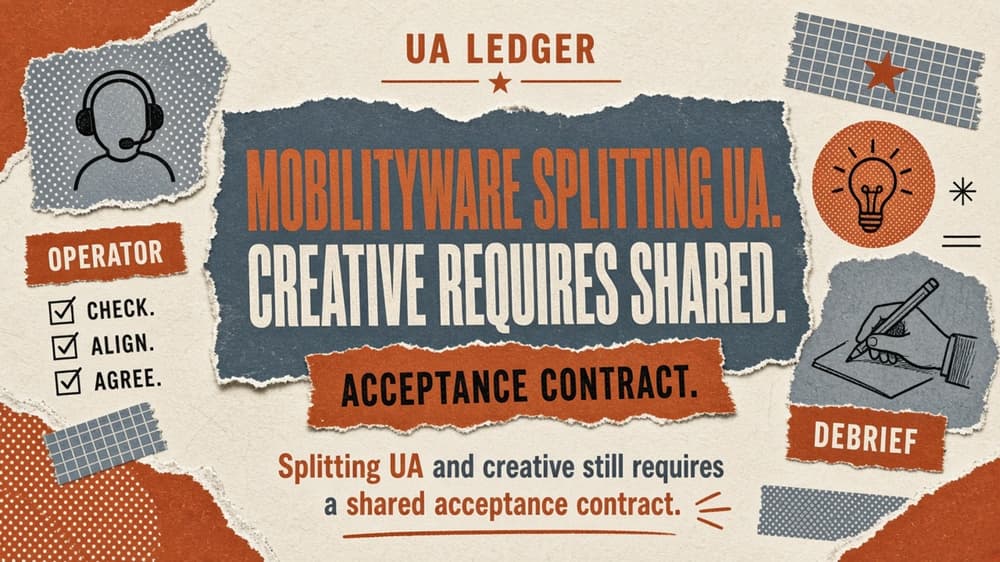
MobilityWare's public case describes making UA and creative distinct practices. The useful organisational lesson is the handoff they must still share when testing a new acquisition route.
MobilityWare's public case describes making UA and creative distinct practices. The useful organisational lesson is the handoff they must still share when testing a new acquisition route.
What the public case establishes
AppsFlyer describes MobilityWare separating UA and creative responsibilities while reassessing its post-ATT media mix. The account discusses a US iOS test with InMobi, measurement through SSOT and messaging variants informed by official store listings. Several operational and campaign changes occurred together. AppsFlyer case study.
This debrief analyses a public customer case published by a commercial supplier. It is not an original UA Ledger interview. The chronology below follows the supplier’s account; we did not inspect the advertiser’s dashboards or interview its staff.
The decision worth examining
Specialisation can improve attention to craft and buying, but it can also leave each team optimising its own local metric. A creative team may deliver readable assets while the buyer lacks a clear hypothesis; a buyer may request variations without preserving the product claim. The shared object should be the experiment specification, with ownership for both the asset and the evidence.
Our handoff worksheet links a store-supported promise, the creative variation, the expected player action and the metric the buyer will inspect. It also names who can stop the experiment for misleading messaging or incomplete data. Those are proposed operating responsibilities, not a claim about MobilityWare's internal staffing or approval process.
A usable next check
Review a planned creative delivery before launch and have the producer and buyer independently explain its hypothesis and success criterion. Resolve discrepancies before rendering further variants. After delivery, verify that each reported asset maps to its actual approved file and destination. Use the exercise to improve the handoff, without requiring the creative team to pretend it controls the auction.
| Test element | Proposed specification |
|---|---|
| Control | Separate production and buying briefs with unmatched success criteria |
| Variant | Shared experiment contract retaining clear team ownership |
| Readout | Hypothesis agreement, asset traceability and product-promise accuracy |
| Stop or reject | Do not launch when the buyer and producer describe different experiments |
Download the populated case worksheet. Its control, variant and decision rules are a proposed experiment, not an account of results already measured. Keep the source URL with the worksheet when circulating it so reported findings cannot become unattributed team benchmarks.
Evidence boundary
The case does not isolate organisational structure as the cause of its reported growth. Historical references to attribution signals are not current privacy or platform-policy guidance, and we have not audited the underlying campaigns.
For background, see reading an mmp dashboard without fooling yourself and cohort quality checklist ua spend. No first-hand campaign result is asserted.