$7.7B in a quarter: Q1 M&A and what consolidation does to CPI
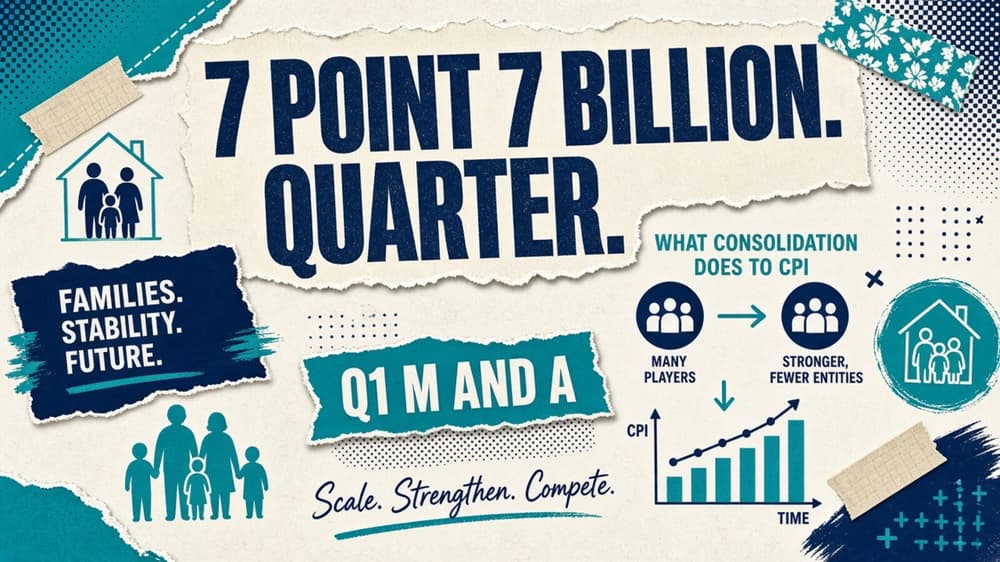
PocketGamer.biz and Aream put Q1 2026 games M&A at $7.7B across 52 deals. What buyer concentration in that total means for CPI in the affected genres.
PocketGamer.biz and Aream put first-quarter games M&A at $7.7B across 52 deals, the highest quarterly total since the post-COVID boom once you strip out megadeals, and more than triple the $2.4B recorded in the first quarter of 2025. Drake Star's broader tally, which folds in adjacent media deals including Paramount and Warner Bros. Discovery, puts total activity north of $100B. For UA budgets the gaming-specific number is the one that matters, and it sits in a handful of large transactions rather than spreading thinly across many small ones.
Who is actually buying
Two deals do most of the work in that $7.7B figure: Savvy Games Group's agreement to buy Moonton from ByteDance for $6B, and Scopely's move to take a majority stake in Loom Games at a valuation above $1B.
Both are strategy-adjacent. Moonton's Mobile Legends: Bang Bang is a MOBA with a long-running live-service audience, and Loom's Pixel Flow has been a top-20 US grossing title. That concentration tells you more than the headline total does, because it points at where the incentive to change spending behaviour actually sits instead of implying some broad industry-wide shift.
What consolidation typically does to CPI
The mechanism isn't complicated. When one owner controls several large titles in adjacent genres, that owner can cross-promote between its own properties instead of buying every install on the open market. Savvy now sits above Moonton, above Scopely, and, through Scopely, above Loom: three assets with reasonably compatible audiences. If Savvy shifts acquisition internally, even partially, then a chunk of high-intent strategy and MOBA volume leaves the open auction altogether. Fewer bidders chasing the remaining pool should, on paper, ease pricing. What usually happens first is the opposite: the acquiring company keeps spending competitively in the open market right through the integration period, partly to protect market share while the internal tooling comes together, partly because folding acquired studios' media buying into a shared stack takes quarters rather than weeks.
The near-term effect is more likely to be noise than relief
Buyers in strategy and MOBA-adjacent genres shouldn't expect CPI relief in the coming quarter or two just because ownership consolidated. What follows a $6B acquisition closing is usually a period of parallel, sometimes duplicated, media buying while the two organisations reconcile their teams and their vendor relationships, and that can just as easily push short-term CPI up in the specific audience segments both properties compete for. The medium-term effect, cross-promotion reducing paid dependency for the owner's own portfolio while everyone else faces the same auction, is the one worth watching. It runs on a slower clock than the deal announcement does.
What this quarter's total does not tell you
A $7.7B quarterly figure invites a broader narrative about the sector consolidating, and the deal list only partly supports it. Outside the two large strategy-adjacent transactions, Q1 activity looks closer to normal deal flow than to a wave. Reading the total as evidence that funding is loosening broadly across the sector would be a mistake: most of the increase over last year's $2.4B baseline comes down to a small number of large buyers making specific, genre-targeted bets, not to capital becoming generally easier to raise for games businesses of any size.
The useful signal for a UA team is not the total deal value but whether the acquiring companies start visibly shifting spend behaviour inside their new portfolios. That shows up in auction data for strategy and MOBA audience segments long before it shows up in a press release. Build a simple quarterly check into your competitive intelligence process and you won't need a headline deal to prompt the question.