State of Mobile 2026: nine Sensor Tower trends for operators
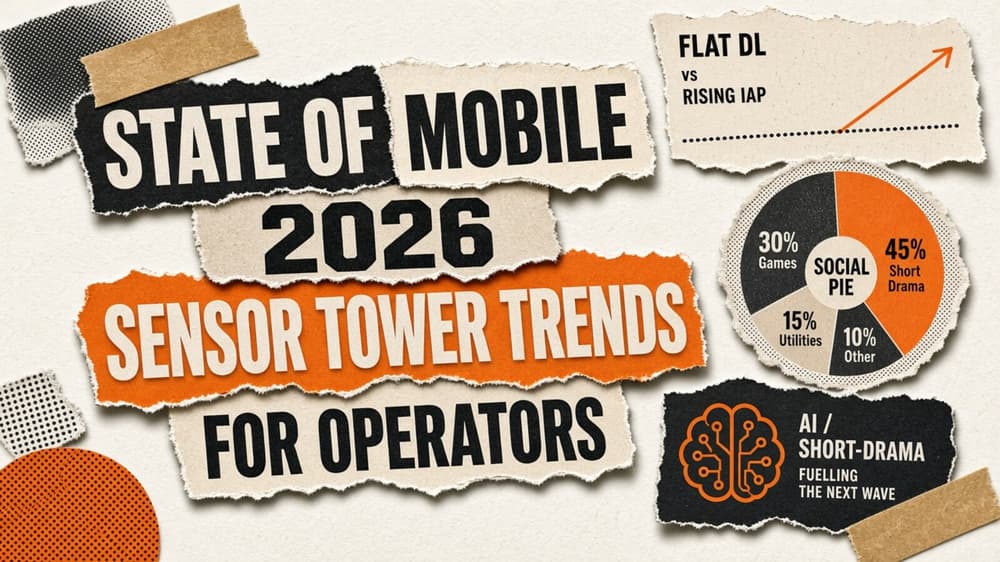
Full-depth archive/ST State of Mobile — nine trends, operator implications, measurement hygiene; metrics qualified.
Jared Gibbons’ prior industry analysis walkthrough of Sensor Tower’s State of Mobile 2026 with Jonathan Briskman (archive date 2026-02-02 — archive editorial date, not UA Ledger first-live) collapses nine charts into one mandate: monetise depth, not install vanity.Supported from Sensor Tower’s State of Mobile 2026 press (21 Jan 2026): global IAP about$167B(+~10% YoY); non-game apps about$85.6B vs games about$81.8B IAP in 2025. Other percentages remain Sensor Tower via prior industry analysis — qualified until primary report tables (period, geo, definitions) are attached.
1. Monetisation first is not a slogan
Downloads about+0.8%year-on-year while IAP about+10.6%. US has telegraphed declining downloads with rising revenue for years; as India/Brazil download explosions matured, the industry pivoted to monetisation. Briskman’s three forces: mobile time up only ~1.1%per user (long-term hours still matter); consumers more comfortable paying (Apple Pay, Venmo, smoother flows); developers better at pricing, trials, subscription mix. Saturation is real: average about 3.6 hours/day barely budging — battle shifts from acquisition to retention and extraction. US mobile spend “nearing$60B” shows mature markets can still grow revenue from existing audiences.
2. Apps pass games on IAP
Non-game apps about$85.6B versus games about$81.8B IAP in 2025 (supported— Sensor Tower State of Mobile 2026 press, 21 Jan 2026; same release puts global IAP near$167B). Gap widening. Apps learned game funnels: widest free audience, enough free to prove value, paywall what users need. Utility justifies pay — Netflix, AI assistants, Spotify/YouTube ad pressure into subscription; book, fitness, productivity apps subscribe users to annual plans with high ARPPU and timed win-back discounts. Games had a quieter year in the archive’s framing —not an absolute “zero new $1B games” claim: ST colour also notes ~18 apps crossed $1B with a games/non-games split (e.g. Pokémon TCG Pocket class). Treat “few new $1B game breakouts” as qualified briefing colour pending a named leaderboard methodology (same family as Match-3D $1B hedges).
3. Strategy won 2025 — spike or regime?
Strategy/4X surged (Last War, Kingshot, Whiteout) across key geos: accessible mini-games, extreme social loops, hard monetisation, and — that archive’s blunt note — large-scale misleading marketing. Not all 4X win; Chinese publishers took the lane while some Western hopes (e.g. Scopely’s Star Trek Fleet Command in the archive’s colour) faded. Royal Match remains casual champion; Gossip Harbor–class contenders watched as throne threats. Roblox complicates benchmarks: platform UGC hours versus fixed content games are different businesses — do not blend retention/revenue comps blindly.
4. Hybrid vs hyper vs casual
Hybridcasual grew revenue; hypercasual expanded engagement; traditional casual revenue declined. Rising CPIs correlating with rising CPMs can revive hypercasual IAA economics after a period when acquisition costs killed the model —colour, not your network invoice. Breakout hooks (Block Blast!, Mahjong Vita named) share immediate comprehension, satisfying loops, and creatives that match product truth.
5. Ad mix consolidation
Video dominates; playables gained share; rewarded video up. Midcore vs casual creative splits matter more. Meta “aggressively returning” is report colour — if Instagram/Facebook consolidate share from TikTok/YouTube, expect CPI volatility, faster creative fatigue, and pressure on AI creative factories. Puzzle ad exposure about+40%YoY with monetisation flat raises overbid versus genuine demand — unresolved without auction-panel data. UA baseline: video craft, playable literacy, velocity across fewer powerful platforms.
Cross-cutting: what “monetisation over growth” changes in planning decks
State of Mobile 2026 is not an argument against UA spend — it is an argument against spend that assumes expanding top-of-funnel. When downloads are flat and social owns most hours, every incremental dollar must buy either (a) higher-quality cohorts into games that already extract well, or (b) creative/product systems that raise LTV faster than CPI inflation. Hybridcasual’s revenue growth alongside hypercasual’s engagement growth is the dual reminder: IAA businesses can breathe when CPMs rise, but only if session product truth matches the ad.
Strategy’s multi-region download growth and Century-class UA factories (covered more fully in the sibling State of Gaming draft) show what “playing at a level most studios cannot sustain” looks like. Mid-tier roadmaps that ignore that asymmetry will keep confusing activity with progress.
Apps overtaking games on IAP reframes competitive set: your real auction rivals for attention and subscription dollars include AI assistants and short drama, not only the puzzle to your left on the category chart. Short drama’s cliffhanger loop is a live-ops content problem solved with AI tooling — games that still treat content treadmills as purely human artisanal calendars will lose cadence wars.
6. Kingmakers: AI assistants and short drama
AI assistants climbed top-grossing; short drama was the breakout growth subgenre. ChatGPT alone$3.4B annual IAP colour, reaching $3B faster than any app in history in this telling — alongside Fortune-linked notes on OpenAI losses (separate P&L story; do not treat IAP as profit). AI assistants monetise via subscriptions, usage, bundles. Short drama: bite-sized narrative, cliffhangers, premium episodes — game-like progression/curiosity/FOMO applied to story; AI makes the content treadmill feasible. Games: fewer new $1B breakouts in the archive’s colour (qualified, not absolute); harder distribution; matured competition.
$3.4B ChatGPT IAP and “fastest to $3B” are ST/archive secondary — qualified; corroborate with primary store intelligence before absolute claims.
7. Social owns 60%+ of mobile time
Social media + messaging over 60%of mobile time; social IAP about$15B (+16%). Device time not growing → brutal attention scarcity; gaming sessions compete with Instagram/TikTok/WhatsApp. Dichotomy: super-long and super-short sessions both expand; the middle shrinks — design must pick a pattern.
8. Emerging markets: India and Pakistan
Among top 10 markets, only India and Pakistan still show positive download growth in this framing. Playbooks: ad-supported models, very low IAP entry prices, localisation, mechanics that work without premium ARPPU. Global publishers must adapt monetisation, not only translate creatives.
9. Most investable models (Briskman via prior industry analysis)
- AI-powered utility— defensible workflow value; ChatGPT-scale willingness to pay as existence proof (hedged).
- Content subscriptions in niches— short drama, education, fitness, pro development; LTV attractive if content pipeline holds.
- Social gaming— connection over pure competition; alliances/creation reduce churn; Roblox / Fortnite creative-mode class examples.
Operator implications across the nine trends
Finance / UA: Rebuild plans around net ROAS and retention depth, not download OKRs. Incrementality and creative velocity are table stakes when Meta consolidates attention formats and puzzle auctions overheat. Treat “hypercasual is back because CPMs rose” as a hypothesis to test on your accounts, not a portfolio strategy memo.
Product / genre: Strategy/4X obligation monetisation and hybridcasual dual yield are the 2025 proof points in this briefing; traditional casual must innovate or accept decline colour. If you chase Gossip Harbor–class throne shots against Royal Match, underwrite content ops and celebrity/creator risk separately — and only name talent you can source.
Apps vs games: Non-game freemium discipline (utility in the ad, annual plans, win-backs) is now the teacher. Game FTUE that ignores the ad→store→session promise arc will keep losing strangers that apps convert.
Attention: Designing for the disappearing middle session is mandatory. Pick deep appointment loops or micro-session loops; measure social time as your real competitor, not only genre peers.
Emerging markets: India/Pakistan download growth (archive/ST colour) rewards ad-led and micro-IAP designs. Translating US whale offers without localisation of price and fantasy is a common failure mode.
Investment lens: AI utility, niche content subscriptions, and social creation platforms are Briskman’s three investable shapes — each needs defensible value or content cadence, not a thin game skin on a subscription paywall.
Apps$85.6B/ games$81.8B/ global IAP~$167B are supported via Sensor Tower State of Mobile 2026 press (21 Jan 2026). Other quantitative claims remain Sensor Tower via prior industry analysis —qualified. The tightened “few new $1B game breakouts” line stays qualified without a named leaderboard methodology, same family as Match-3D duopoly hedges.
Measurement hygiene for this briefing
When quoting any figure from This article in decks, pair it with: source = Sensor Tower (press 21 Jan 2026 for $85.6B/$81.8B/$167B; else Sensor Tower via prior industry analysis 2026-02-02 archive); status =supported for those three IAP totals, qualified for other archive-only figures; and the explicit non-claim that archive date ≠ UA Ledger first-live. ChatGPT IAP colour is not OpenAI profitability. Social 60% time is not “games are dead” — it is the competitive set for attention. Apps’ IAP lead is a freemium-discipline warning for game teams that still sell fantasy in ads and extraction in shops.
Conclusion for operators
Growth-at-all-costs is over. Downloads flat, time saturated, acquisition costly — winners master monetisation, retention, and value. Apps teach freemium; AI opens WTP; social takes majority attention; remaining mindshare is expensive. Keep every ST percentage labelled; archive date is not first-live; no publish from this.
Archive mechanism depth (operator rewrite)
The following rebuilds that archive’s remaining mechanism detail in Samuel Ortiz voice: systems, evidence posture, and operator implications — not filler and not a repeated checkpoint stanza. This is historical product truth from the archive date, not a claim of 2026 freshness.
State of Mobile 2026: 9 Trends That Matter
That archive’s “State of Mobile 2026: 9 Trends That Matter” passage is restated here as product-truth for Games & Genres operators: what the system does to behaviour, how monetisation attaches, and what that implies for creative and measurement. Archive figures stay qualified/unresolved until Fact Checker attaches a primary or named panel.
Based on prior industry analysis podcast episode featuring Jonathan Briskman, Director of Market Insights at Sensor Tower. For the full State of Mobile 2026 report with interactive graphs and deeper data, visit Sensor Tower’s website.
The mobile industry in 2026 presents a fascinating paradox: downloads remain flat while revenue soars. In this deep dive with Sensor Tower’s Jonathan Briskman, operators explore nine critical graphs that reveal the fundamental shifts reshaping mobile strategy.
From the rapid overtaking of games by apps in IAP revenue to the emergence of AI assistants and short drama as new kingmakers, these insights challenge conventional wisdom about mobile growth, monetisation, and competition for user attention.
1. Monetization First Isn’t Just a Slogan
That archive’s “1. Monetization First Isn’t Just a Slogan” passage is restated here as product-truth for Games & Genres operators: what the system does to behaviour, how monetisation attaches, and what that implies for creative and measurement. Archive figures stay qualified/unresolved until Fact Checker attaches a primary or named panel.
That archive’s archive states that downloads are essentially flat, up just 0.8% year-over-year, while in-app purchases surged 10.6%. This is a structural shift. The US market has been telegraphing this trend for years, with downloads actually declining while revenue climbs. As high-growth markets like India and Brazil matured and slowed their explosive download growth from five years ago, the industry's focus pivoted decisively toward monetisation —qualified/unresolved without a named intel-panel cut.
That archive’s archive states that 1. First, increased mobile time, though this year it's only up 1.1% per user, the long-term trend of people spending more hours on mobile naturally translates to spending more money where they are. 2. Second, consumers have become dramatically more comfortable paying on mobile devices. The ubiquity of Apple Pay, Venmo, and seamless payment flows has eliminated friction. 3. Third, developers have mastered monetisation optimization, better pricing strategies, sophisticated trial funnels, and the right mix of subscriptions versus one-time purchases —qualified/unresolved without a named intel-panel cut.
Portfolio read on “1. Monetization First Isn’t Just a Slogan”: steal the system pattern only when the current slate has an analogue reachable in the first sessions; otherwise the historical boast is costume.
But the saturation is real. The average time per user sits at 3.6 hours per day, barely budging. With only so many hours in the day to reach users, the battle has shifted from acquisition to retention and monetisation.
That archive’s archive states that the US market, nearing $60 billion in mobile spend, demonstrates that even in mature markets, revenue can grow when developers focus on keeping users engaged and extracting more value from existing audiences —qualified/unresolved without a named intel-panel cut.
Live-ops implication from “1. Monetization First Isn’t Just a Slogan”: if the system creates appointment or fail-state timing, align CRM and media flights to that window rather than a generic always-on cadence.
Bottom line
Steal system patterns and measurement questions from this archive; keep archive-only metrics qualified/unresolved; no publish from this. Archive editorial date is not UA Ledger first-live.
Related posts

market intelligence
media buying
·1 min read
Lunar New Year UA gates from an official calendar, not a CPI myth

market intelligence
media buying
·2 min read
WeChat Mini Games upgrades 2026 IAP / virtual-payment incentives for debut titles

market intelligence
media buying
·2 min read