The UA system platforms will not build for you
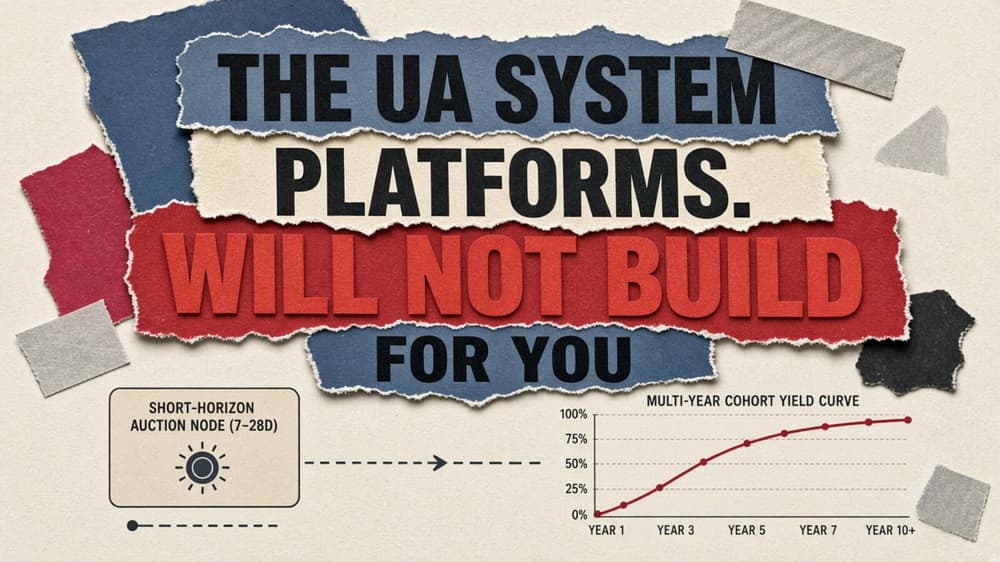
Networks optimise seven-to-twenty-eight-day proxies; games need multi-year yield. A Games & Genres / market-intelligence read of the translation layer, learning loop, creative velocity, and org design publishers must own themselves.
Ad networks keep getting better at the same job: optimise toward revenue they can observe inside roughly seven to twenty-eight days. That window is qualified industry structure—aligned with common MMP and bidding practice and with products such as Unity Ads’ D7/D28 IAP ROAS documentation—not a single primary network policy PDF. E-commerce often resolves inside it. Live games do not.
Two installs with identical D28 ARPU can diverge wildly by month twelve—one already churned, one still compounding LiveOps value—yet the bidder treats them as equal. Networks are designed to arbitrage observable proxies. Nobody on the other side of the table is incentivised to close the gap for you. That mismatch is not a dashboard bug. It is the structural place where publisher margin is won or given away.
This piece restates, in UA Ledger voice, the system argument Josh Chandley (WildCard; UA Monthly host) laid out on prior industry analysis. Primary desk is market-intelligence; the operating implications sit next to media-buying and creative production. Podcast CTAs in the source are ignored per commission.
Short-horizon networks, long-horizon publishers
Networks watch what happens in the observation window, learn which users convert, and buy more of them. Publishers pay studio overhead against multi-year relationships. The value of a user acquired today will not be fully understood for months—sometimes years. No single party owns the translation between short-horizon proxy metrics and long-horizon yield.
That gap is the defining tension in mobile UA. For most publishers, nobody has explicitly claimed it. Claiming it is not “better campaign hygiene.” It is owning the map from boardroom objective to bid-level calibration—and maintaining that map as attribution, seasonality, and mix shift.
From boardroom to bid: yield architecture
Closing the gap starts with a question studios often skip: what are you actually optimising for? For live titles, the decision sits on a spectrum Chandley states explicitly:
- Maximise IRR on deployed capital(including studio overhead) — tighter spend, higher ROAS hurdles, better capital efficiency.
- Maximise absolute dollar yield— more spend, more risk, lower ROAS, larger total profit in dollars.
That is not a UA decision. It is a business-strategy decision. If leadership never chooses, UA defaults to topline because topline is easy to screenshot. That is a strategy failure labelled as a channel problem.
Once the objective function is set, translation work begins. Each network delivers users with different LTV curves, retention shapes, and monetisation profiles. A user acquired through one network matures differently than a user from another. The same D28 ARPU may hide incompatible D720 LTVs.
Operator-first rule: set network- and algorithm-specific short-term ROAS targets that back into one long-term objective. A single universal D7 or D28 target across all networks either overpays weak supply or underscales strong supply. Both cost money. Neither is visible if you only read the platform dashboard.
That archive’s diagram (summarised, not reproduced): left panel—same D28 target, wildly different long-term returns; right panel—same long-term goal requiring different D28 targets per network. The UA team’s core job is owning that translation from business objective down to campaign-level calibration. The map shifts constantly. Network performance changes. Attribution models disagree on who caused the install. Seasonal swings move curves quarter to quarter. Maintaining the map *is* the job.
Most studios have a boardroom strategy and network-level execution. They have too little in between. The team that owns the translation layer owns growth. The team that only “manages campaigns” rents growth from the networks.
Measurement that changes decisions
The translation layer runs on data the networks do not provide. Beyond the ~D7–D28 window, the studio must own cohort maturation tracking, model-based LTV estimation, and incrementality against true returns—not only MMP mirrors of platform-reported success.
Most studios call this “analytics.” If it produces dashboards that never retarget bids, creative mix, or product priorities, it is a reporting function—a cost centre. Measurement that reshapes plans is a growth function.
Product improvements to retention should proactively recalibrate acquisition targets. Major marketing portfolio changes should feed back into the product roadmap. When those connections do not exist, everyone sees numbers and nobody acts. Genre and meta changes—a new fail condition, season structure, economy tighten—should move UA targets deliberately. Otherwise you keep buying yesterday’s LTV curve.
Eventually the publisher automates its side of the system and connects it to networks that are already automated: robots talking to robots. The growth leader architects the system, sets the objective function, and knows when to override both.
Growth learning loop (five properties)
Every system in Chandley’s argument depends on the same five properties. When they are healthy, knowledge compounds. When any one degrades, the loop optimises noise. Find the bottleneck; that is the growth-rate cap.
- Signal clarity— Structure inputs so data points to a decision, not only an outcome. If creative taxonomy does not tag hook type, format, and emotion independently, a winning ad teaches almost nothing: there is no benchmark.
- Latency— Gap between data and action. A network degrading this week should lose budget near real time, not on the next monthly council.
- Gain— How aggressively you change course. Found a creative champion after six months of search? Can you ship three variations tomorrow, or does production take three weeks? Move too slowly and competitors catch up before you double down.
- Receiver capacity— Translation, especially for creative leads. Raw ROAS means nothing until it becomes language like “vulnerability hooks outperformed confidence by 40%” (labelled modelled example, not a Ledger campaign result). Data that is not understood drives dashboards nobody reads.
- Loop closure— Separates a system from a process. Every budget allocation must reference last cycle’s projections versus actuals. Without a forcing function in the workflow, feedback gets nodded at and ignored.
Signal flows through the loop in sequence. When one property degrades, the whole system slows.
Creative as highest-frequency input
Creative is the last input publishers still control tightly. Higher IPM at constant scale lifts ROAS; the IPM gap versus competitors is still publisher-controlled alpha the platform does not own. That alpha is under threat. AppLovin and Meta are building AI creative tools that generate volume natively inside the auction, optimising against signals nobody else can see. Networks will own baseline creative. That is inevitable. Baseline gets you parity, not margin. The gap between baseline and breakout is where yield lives.
Budget shifts, measurement updates, and target recalibrations all matter. Creative is the input you can change every day. Without enough volume, the learning loop starves for signal.
Signal clarity requires enough variants to isolate what works. Ship one untagged concept per week and a win is an anecdote: was it the hook, the mechanic, the emotion? You do not know—you tested one combination. Ship twenty tagged variants and the system starts pointing to mechanisms that compound, not only outcomes. (Modelled volume example—labelled guidance, not a prescribed studio quota.)
The floor for minimum viable creative volume rises every quarter. Studios below it starve the loop. The gap between baseline and breakout stays open only for studios producing fast enough to find breakout before competitors copy it.
That window is shrinking. A winning format might give two months before the market replicates it. When networks agentically generate variants of what is scaling, half-life can collapse toward days. The advantage is not having a winner. It is having production velocity to find the next one before the last decays. Defence is clock speed, not taste mythology. Treat creative as a production system feeding the learning loop—not as craft mythology that refuses volume.
Org shape scales with spend (consulting guidance)
That archive’s org diagrams (summarised, not reproduced) are consulting guidance, not a Ledger org audit or surveyed industry median. Adapt to portfolio reality.
From about $500k monthly spend: structure stays lean, but functions already need to be distinct. Ad monetisation, if applicable, sits alongside UA—buy side and sell side of the ad economy need tight coordination at this scale. If there is no data/translation owner yet, that is the first hire. Without it, nobody owns the translation layer.
At $5–15M: functions become directorates. With a portfolio, dedicated UA leads by genre, monetisation strategy, or title matter—because a puzzle game and a strategy game have fundamentally different LTV curves, creative languages, and audience behaviours. Running them through one undifferentiated team breaks translation and degrades every learning-loop property. Creative grows but often stays at least partially independent; if too little spend goes to new creatives, a Creative Strategist becomes a must-have. Breaking out ASO is optional. Data scales into analytics and engineering. Automation, tools, and measurement infrastructure become competitive advantages, not only overhead.
At $25M+: full architecture becomes visible. Three directors report to a VP Growth: UA, Creative, and Ad Monetisation. Two dotted lines: Product and Data. Each segment gets its own UA, Creative, and Product leadership. ASO becomes its own function. This is the org that can run translation, learning loop, measurement architecture, and product feedback together. One growth leader; one system. Beyond a certain scale, additional VPs may break the portfolio into digestible pieces.
One thing the charts do not show: where the growth function’s boundary ends. Increasingly, it does not—because shared surface area with Product is growing, not because Growth “takes over” Product. The path from first impression to year-two yield runs through onboarding, retention, and LiveOps. Creative is the first seven seconds of the product experience. Retention data recalibrates acquisition targets. LiveOps signals reshape which creative archetypes get seeded next. UA does not end at the install anymore. It ends at year two.
What “translation ownership” looks like week to week
Owning the translation layer is not a quarterly strategy offsite. It is a recurring operating rhythm:
- Recompute network-specific D7/D28 targets when mix, seasonality, or attribution shifts—not when someone notices ROAS “feels off.”
- Write the map down so creative, product, and finance share one objective function (IRR vs absolute yield) instead of three silent ones.
- Kill universal ROAS targets that look tidy in a deck and quietly starve the best long-curve network.
- Feed retention wins into bids within days of a LiveOps or economy change, not after the next planning cycle.
- Treat MMP–platform disagreement as expected, not as a crisis—the translation layer exists partly because those systems will never fully agree.
If that rhythm does not exist, the studio has boardroom language and campaign buttons—and a hole where margin is negotiated.
Product ↔ UA feedback (genre desk view)
Games & Genres changes are acquisition events whether UA is invited or not. A new fail condition, season structure, or economy tighten changes who stays and who pays. If bids still optimise last season’s LTV curve, you are buying yesterday’s user into today’s product.
Practical loop:
- Product ships a meta or economy change with an expected retention/ARPU directional impact.
- Growth revises network-level short-horizon targets and creative seeding hypotheses in the same sprint.
- Measurement checks whether cohort maturation moved as modelled—then closes the loop in the next allocation.
Without step 2, product “wins” never become cheaper or better-scaled users. Without step 3, UA keeps running anecdotes.
Where teams usually fail the five properties
Chandley’s loop is most useful as a bottleneck finder:
- Weak signal clarity looks like “this ad won” with no tagged hook/format/emotion—so production cannot reproduce the win.
- High latency looks like a degrading Android network still funded until the monthly council.
- Low gain looks like a champion creative waiting three weeks for variants while competitors remix in days.
- Poor receiver capacity looks like ROAS dashboards creative leads ignore because nobody translated them into brief language.
- No loop closure looks like budget moved on vibes while last cycle’s projection-vs-actuals deck went unread.
Fix the bottleneck you actually have. Adding headcount to a team that cannot name hook types will not raise IPM.
Bottom line
Platforms own targeting and short-horizon optimisation. What you build around them determines margin.
The translation layer. The growth learning loop. The measurement architecture. The team that runs it. The growth leader who knows when to trust the machine and when to override it.
Networks will keep optimising for what they can see inside roughly D7–D28. The studio that owns the translation between their week and your year-two yield—objective function, per-network targets, decision-grade measurement, creative velocity, and an org that closes the loop—is negotiating for the margin. Genre teams feel this when a meta change moves LTV but bids do not. UA teams feel it when a universal ROAS target quietly starves the best long-curve network.
Nobody across the table is building that system for you. That is the point of owning it. Everyone else is letting the networks decide how much they make.
Related posts

market intelligence
media buying
·1 min read
Lunar New Year UA gates from an official calendar, not a CPI myth

market intelligence
media buying
·2 min read
WeChat Mini Games upgrades 2026 IAP / virtual-payment incentives for debut titles

market intelligence
media buying
·2 min read