Narrative games need a different funnel
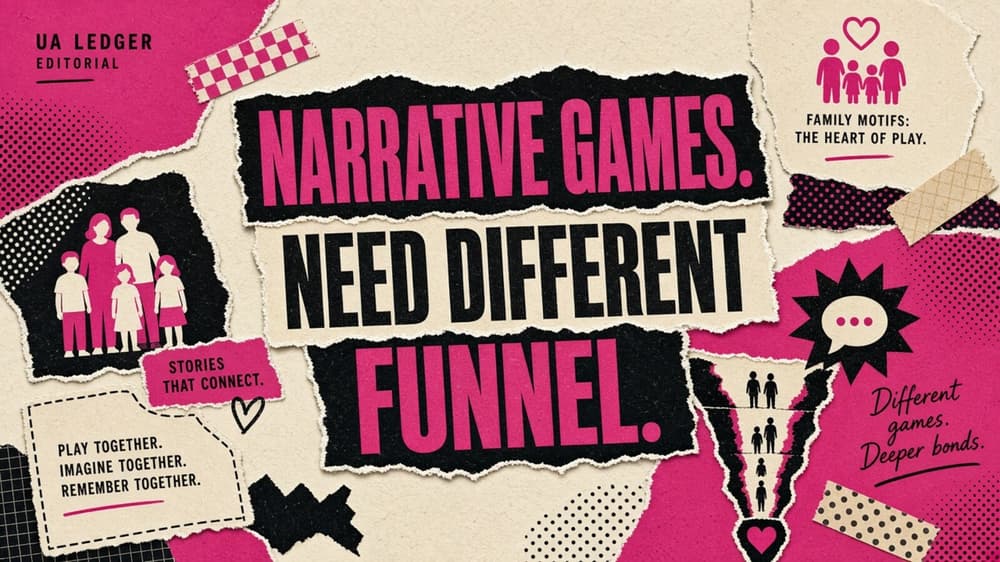
Narrative and choice games fail when bought as install funnels. The product is a story people return to, and the funnel should be built on chapters.
Narrative and choice games are bought wrongly by most of the teams that market them. They are run through an install funnel built for casual games: optimise toward an early event, judge creative on cost per install, read retention at day one and day seven. The product does not work that way. A narrative game is closer to a serial than to a game, and the thing being sold is the desire to know what happens next. The funnel should be built around chapters and returns, with the ad itself serving as chapter zero.
A reasonable practitioner might object that the standard funnel has scaled plenty of story titles. It has. But the genre's chronic problems, high early churn, spoiler-driven creative and a reputation for misleading ads, are all symptoms of the same mismatch, and the mismatch is mechanical rather than cultural.
Why early-event optimisation misfires
Automated bidding learns from the conversion events it receives in the first day or two. A puzzle or merge game produces a dense stream of those events: a rewarded ad, a small purchase, a level cleared. A narrative game produces very little in that window. The first chapter is usually free, the first meaningful spend arrives when a player wants a premium choice several chapters in, and the timing of that spend depends on reading pace, which varies enormously between people.
The network's model, starved of early signal, does what it always does: it finds the users who resemble whoever converted fastest. In a narrative game those are often the people who tap through choices at speed and buy an outfit in chapter two. They are not the readers who stay for forty chapters. Optimising toward the early buyer selects against the long-term one.
The fix is not to abandon event optimisation but to send different events. Chapter completion is the genre's honest signal. A player who finishes chapter one and opens chapter two within twenty-four hours has demonstrated the only behaviour that predicts value in this category, and that event can be sent to the network in place of a purchase proxy that arrives too rarely to learn from.
The spoiler paradox
The creative side has a paradox that most coverage treats as a scandal rather than a mechanism. Story creative that shows the most dramatic moment converts best on cost per install and worst on retention, because the ad has already spent the thing the game was going to sell. The player arrives knowing the twist. The reason to return has been used up in the feed.
That is why the genre drifted toward the borrowed dramas, the fake-narrative choice hooks that were lifted from other categories and eventually worked their way back into them. Those ads perform on install because they promise a scene the game cannot deliver, and the resulting cohorts leave when the promise fails. The February report from Mintegral and Insightrackr noted short-drama apps surging, which is worth watching for a different reason: those apps are selling exactly the serialised cliffhanger that narrative games should be selling, and they are doing it honestly, one episode at a time.
The better model for creative is a cliffhanger, not a climax. Show the setup, cut on the choice, do not show the consequence. It costs more per install, because it asks the viewer to be curious rather than shocked. It costs less per reader.
The chapter funnel
Here is the framework, built as a decision rule rather than a dashboard. Every stage maps to a chapter, and every metric is a return rate rather than a count. The figures below are illustrative examples, not benchmarks.
- Chapter zero is the ad. Its job is to leave a question open. It is judged on the share of installers who reach the end of chapter one, not on install cost.
- Chapter one is the free sample. The optimisation event sent to networks is chapter one complete and chapter two opened. If, hypothetically, fewer than half of installers get there, the creative is selecting the wrong audience or the opening is too slow, and the answer is almost never a cheaper bid.
- Chapter three is the value gate. The metric is return within seventy-two hours of finishing chapter three. This is where readers and tourists separate, and it is the earliest point at which predicted lifetime value means anything.
- Everything after is retention, and retention here is a content-release problem as much as a marketing one. A UA team cannot buy its way past a story that has run out of chapters.
The decision rule that follows: budget is allowed to scale only when the chapter three return rate for the newest cohort matches or beats the previous cohort's. Cost per install is reported but is not a scaling trigger. Teams that adopt this tend to spend less in week one and more in month three, which is the right shape for a serial.
The trade-off nobody mentions
Building the funnel around chapters shifts the constraint from marketing to production. A narrative game that acquires readers rather than tourists will run out of content faster, because readers read. The UA team that fixes its funnel can find it has created a content-velocity problem for the writers' room, and the studio's economics now depend on how quickly it can ship chapters that hold the standard the ad promised.
That is a good problem to have compared with the alternative, but it is a real one, and it argues for the marketing and narrative teams sitting in the same planning meeting. The ad is the first chapter. The people writing the two should at least have met.
Discovery is changing around this genre too. Google's I/O announcements last week included game discovery inside the Gemini app, and story titles are unusually well suited to being recommended in natural language, because they can be described the way a book is described. A game whose store presence reads like a synopsis rather than a feature list will do better in that kind of surface, and the same discipline that fixes the ad fixes the listing.
Related archive reading
Related posts

market intelligence
media buying
·1 min read
Lunar New Year UA gates from an official calendar, not a CPI myth

market intelligence
media buying
·2 min read
WeChat Mini Games upgrades 2026 IAP / virtual-payment incentives for debut titles
market intelligence
media buying
·2 min read