UA metrics explained: CPI, ROAS, LTV and payback
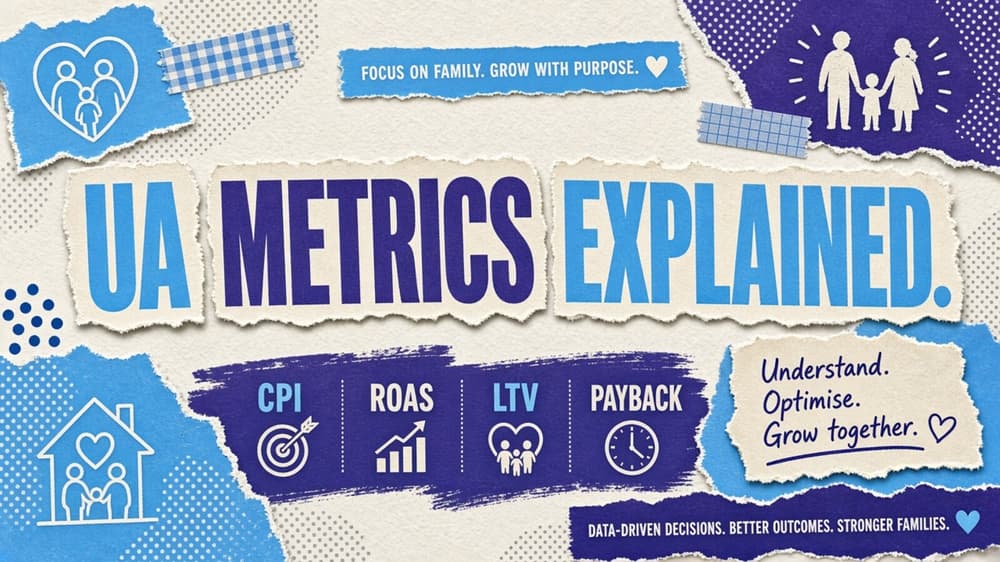
CPI is cost per install, ROAS is return on ad spend, LTV is lifetime value, and payback is when cumulative revenue matches spend.
CPI, cost per install, is media spend divided by the installs it produced. ROAS, return on ad spend, is the revenue a cohort has generated divided by what it cost to acquire, usually measured at a fixed window such as day seven or day thirty. LTV, lifetime value, is the revenue a player should generate over their full time in the game; nobody observes it in full, so teams project it forward from early behaviour. Payback period is the point at which cumulative revenue from a cohort equals what the studio spent acquiring it. Four numbers, one trade. Each looks at cost against value from a different angle, and none of them means much read on its own.
The four terms recur in every campaign report a UA team sees, in every board deck and in every vendor pitch. Vendors selling bidding tools or measurement platforms will lead with whichever metric flatters their product most. Knowing what each one measures, and what it deliberately leaves out, is the difference between reading a dashboard and letting a dashboard lead you.
What is CPI, and what does it not tell you?
Say a campaign spends 10,000 (a round illustrative figure) and produces 2,000 installs. CPI is 5. That number says nothing about whether those 2,000 players will ever generate revenue, whether they retain past day one, or whether they resemble the game's best existing players at all. CPI is a media efficiency metric. It's useful for comparing one campaign or creative against another on cost alone, but a studio that optimises purely to lower CPI will attract cheaper, lower-intent traffic, because the auction finds whoever clicks for less rather than whoever is worth more.
What is ROAS, and over what window?
Continuing the illustrative example, suppose that same cohort of 2,000 players has generated 3,000 in revenue by day seven. Day-seven ROAS is 3,000 divided by 10,000, or 30 percent. The window matters enormously. A day-seven ROAS of 30 percent might be a strong result for a mid-core game with a long monetisation curve and a weak one for a hyper-casual title that should recover most of its spend within a week. ROAS quoted without a stated window is close to meaningless; comparing a day-seven ROAS from one campaign against a day-thirty ROAS from another is a common way teams fool themselves into believing a channel underperformed when the comparison was simply unfair.
What is LTV, and why is it always a forecast?
Nobody observes LTV until a cohort has fully churned, which for many games means nobody ever observes it at all. In practice teams model it. They take early revenue and retention curves from a cohort's first days or weeks and extrapolate forward along a decay curve fitted to how previous, more mature cohorts behaved. If a hypothetical cohort has generated 1.50 per install by day seven (again, an illustrative figure) and previous cohorts typically generate roughly three times their day-seven revenue by day one hundred and eighty, a model might project an LTV near 4.50 per install. That projection carries real uncertainty, particularly early in a game's life before a mature cohort exists to calibrate against. Test any predicted LTV model against a simple ratio-based baseline before trusting it enough to bid against.
What is payback period, and how does it tie the others together?
Payback period asks a simpler, more concrete question than LTV: at what point does cumulative revenue from a cohort equal what the studio spent to acquire it. If CPI was 5 and a cohort's cumulative revenue per install reaches 5 by roughly day forty five, forty five days is the payback period, again treating these as round, labelled example numbers rather than a claim about any specific game. Finance tends to care about this metric most directly, since it answers a cash-flow question (how long is money tied up) rather than the profitability question ROAS and LTV each try to answer in their own way. A studio can have an attractive projected LTV and still run into trouble if the payback period outlasts its cash runway.
Where do these metrics get misread?
The most common misread is treating a short-window ROAS as a verdict on a channel's quality when the true payback point sits weeks or months further out; a channel that looks weak at day seven can be the best-performing one by day sixty for a game with a slow monetisation curve. A second misread compares blended ROAS, which includes organic installs the campaign didn't pay for, against paid-only spend. That flatters performance, and an earlier UA Ledger piece, Blended ROAS Calculation: Where It Quietly Goes Wrong, covered it in detail. A third applies LTV models built on one genre's decay curve to bids in a different genre, even though the retention shape of a puzzle game differs sharply from the monetisation shape of a strategy title. The fix is the same in each case. State the window, state whether a number is paid-only or blended, and treat any LTV or payback figure as a model with an error bar, not a fact.
Put together, these metrics describe a single decision rather than four separate ones. CPI sets the entry cost of a cohort. ROAS at a given window says how much of that cost has come back by that point. LTV projects how much will eventually come back in total, which tells you whether a channel that looks weak at day seven deserves continued funding. Payback period translates that projection into a cash timeline finance can plan against, and this is why a UA team defending a budget increase should walk into that conversation holding a payback figure rather than just a projected LTV, since the second answers "is this profitable" while the first answers "when do we get the money back". A campaign can pass the LTV test and fail the payback test. In a studio with tight cash flow, the payback answer usually decides the budget.