Localisation Inside the Playable Ad: Text, Gesture, Pacing
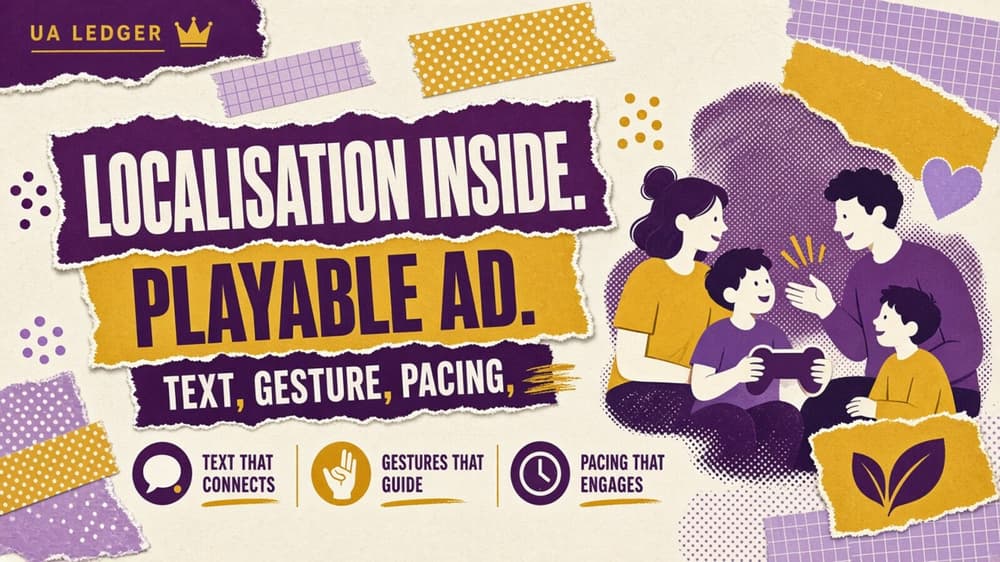
Localisation for playable ads fails most often on gesture and pacing, not translated text, and the fix needs a native reviewer, not just a translator.
Good localisation for playable ads is not a text swap. A pass that only translates copy is a translation pass wearing a localisation pass's job title, and the gap between the two is exactly where playable performance quietly degrades market by market without anyone flagging why.
Text is the easy 20 percent of localisation for playable ads
String replacement is mechanical and mostly solved. Pull the copy, translate it, drop it back into the same layout, check for overflow on languages that run longer than English. Teams that have shipped a handful of playables across markets already have this part automated or close to it. The problem is that text is rarely where a playable actually fails a new market. It is where teams stop looking, because it is the part of the job that has a visible pass or fail state: a truncated button label is obviously broken in a way a bad tap gesture is not.
Gesture is where playables actually break
A tap-to-fire mechanic reads as an aggressive, active gesture in some markets and a casual, low-stakes one in others. A swipe-to-match mechanic that feels satisfying at one speed in a Western market can feel either sluggish or frantic at the same speed elsewhere, because expectations about interaction pacing are shaped by the mobile game genres most popular in that market, not by the ad's own internal logic. A playable built and tuned entirely against one market's testing data is quietly encoding that market's gesture expectations into what looks like a universal mechanic.
The fix is not to redesign the mechanic per market, which is rarely worth the production cost. It is to test gesture responsiveness (tap sensitivity windows, swipe distance thresholds, animation timing on feedback) as a market-specific variable during QA, the same way text length is already tested, rather than assuming a mechanic tuned for one market transfers cleanly.
Pacing is the subtlest failure and the most expensive one
Pacing covers how quickly a playable reveals its hook, how long a tutorial beat lasts before the player is left alone with the mechanic, and how much dead time sits between actions. A pacing rhythm calibrated against one market's attention patterns can feel rushed in a market where players expect more onboarding before being left alone, or feel padded in a market that expects to be dropped straight into the mechanic. Unlike text or gesture, pacing failures rarely produce an obvious bug report. They show up weeks later as unexplained CVR softness in a specific geo that nobody can immediately trace back to the playable, because the mechanic technically works fine in every market, it just does not feel right in some of them.
Colour, iconography and the localisation backlog problem
A resource icon, a colour used to signal danger or reward, or a symbol used for progress can carry different associations across markets in ways that have nothing to do with translation. A red resource counter that reads as "urgent, spend it" in one market can read as simply decorative in another where red carries no equivalent cultural weight in a game context. None of this shows up in a translation QA pass, because there is no text to check, and it rarely gets flagged by a team testing only in its home market because the icon works perfectly well there. A native-market reviewer catches this class of issue for the same reason they catch gesture and pacing problems: they are testing the whole experience against their own market's expectations, not checking a checklist item by item.
This is also why treating localisation as a single pre-launch task rather than an ongoing backlog is a common structural mistake. Markets evolve, mobile gaming conventions shift within a market over eighteen months, and a playable localised well for a market two years ago may no longer reflect that market's current expectations. Studios running franchises across many markets over multiple years get more value from maintaining a living localisation backlog per market, tracked alongside the creative testing calendar, than from treating each new playable's localisation as a fresh, standalone task disconnected from what was learned on the last one.
A checklist for genuine localisation for playable ads
- Route every playable through a native-market reviewer, not just a translator, before it ships to that market's ad networks. A translator can confirm the words are correct; only a native reviewer can confirm the pacing and gesture feel right.
- Test tap sensitivity, swipe thresholds and animation timing per target market during QA, not only during initial development, since these were likely tuned against whichever market the team playtested first.
- Track CVR and playable completion rate by market as a standing dashboard, not a one-off launch check, since pacing mismatches often surface as a slow drift rather than a sharp drop.
- Budget review time for markets with meaningfully different mobile gaming conventions (a market where hyper-casual dominates versus one where longer-session RPGs dominate) as a distinct QA line item, not folded into general localisation cost, because the risk profile is different.
- Keep a running log of gesture and pacing adjustments made per market, so the next playable in the same franchise starts from that market's known preferences rather than relitigating the same discovery each cycle.
The production cost is smaller than the CVR cost of skipping it
The instinct to treat localisation as a late-stage, low-cost pass is understandable given production timelines, but it inverts the actual cost structure. A native review pass adds a day or two to a playable's QA checklist, the kind of discipline covered in more general terms in The Playable Ad QA Checklist to Run Before Submission. A pacing mismatch that quietly depresses CVR in a market for the life of a campaign costs considerably more than that, and it is much harder to diagnose after the fact than it would have been to catch during proper localisation for playable ads before launch.