A Localisation Workflow for Playable Ads That Holds
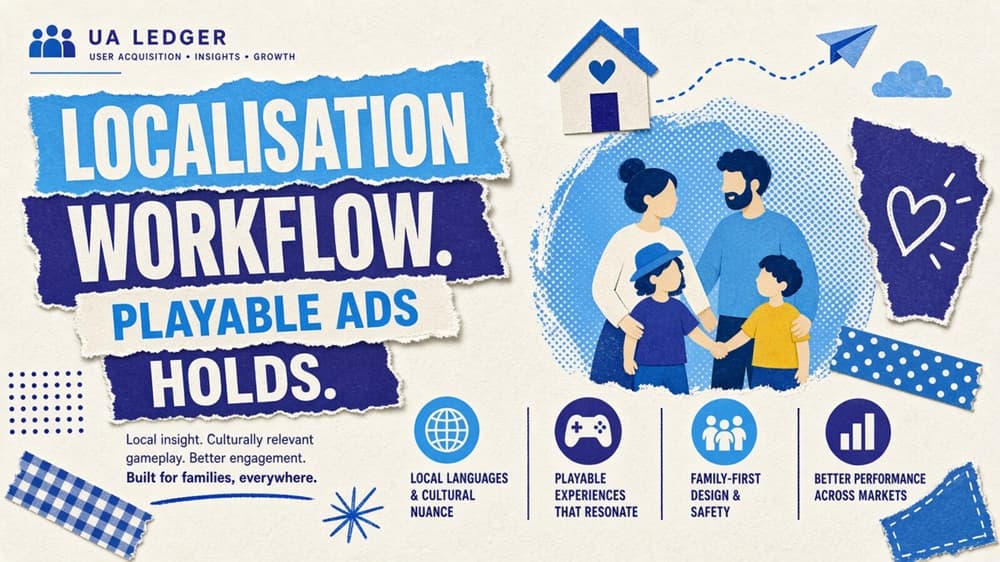
A localization workflow for playable ads has to survive a last-minute market request. Text expansion, gesture and pacing checks that hold up.
A playable ad's localisation workflow gets tested the moment a media buyer asks for one more market two days before a campaign goes live. A localization workflow for playable ads that only works when there's time to rebuild each locale from scratch isn't a workflow; it's a hope that the short-notice request never comes. Build the checks in from the start. Text expansion, gesture behaviour, pacing: those are what let a playable survive that request without a full rebuild.
Text expansion breaks layouts before it breaks meaning
English strings translated into German or Finnish can expand by thirty to forty percent. A button or a tooltip sized to the English text will clip or overflow long before the translation itself is wrong. The fix isn't translating more concisely, since that fights against accuracy. It's building interface elements with expansion headroom from the first build, which means testing button containers and label containers against a placeholder string roughly forty percent longer than the English original before any real translation lands, so the layout has already proven it can hold the length rather than revealing the failure when a translator's file comes back.
Gestures do not translate the same way logos do
A swipe-to-reveal mechanic or a specific tap pattern that reads clearly to one market's players can read as unfamiliar or even confusing in another, and a mechanic borrowed from a different game genre entirely can carry different expectations by region. This is easy to miss. Nothing about it looks broken in QA when the reviewer is testing in one market's context. The practical fix is a short note in the playable's build spec calling out every gesture the mechanic depends on, so a market-specific QA pass has something concrete to check against rather than a general sense of whether it feels right, which tends to default to the reviewer's own market's assumptions.
Pacing has to hold when read time changes
A tutorial beat timed against how quickly an English-reading player parses a five-word instruction will feel rushed in a market where the equivalent instruction runs to eight or nine words, or where reading direction changes the flow of attention across the screen entirely. Auto-advancing tutorial steps on a fixed timer is the single most common cause of a playable that tests well in its source market and falls over in a new one; somebody calibrated the timer to one language's reading speed and nobody revisited it. Tie tutorial advancement to a player action rather than a clock and this failure mode disappears, at the cost of slightly less control over exact ad length.
Right-to-left and double-byte markets need a separate pass, not a translation swap
Adding an Arabic or Hebrew market isn't the same job as adding a second European language, because the interface itself needs to mirror, not just the text within it. A progress bar, a swipe direction cue, an arrow indicating where to tap: each carries directional meaning that a straight text swap doesn't touch, and a playable that only flips the text while leaving directional UI elements alone produces a build that reads as broken to a right-to-left market even when every word has a correct translation. Double-byte languages like Japanese or Korean create a different problem. Character count is a poor proxy for expansion risk there, since a short Japanese string can still take more visual width per character than a Latin one, so testing against a generic expansion buffer built around European languages won't catch every failure in a CJK market. Treat right-to-left and double-byte markets as their own QA pass, with their own checklist items, rather than folding them into the review used for a second European language; that catches problems the standard pass was never built to see.
A pre-flight checklist for a last-minute market
A workable checklist for adding a market under time pressure: confirm every text container has passed a test against an expansion buffer, not just the source-language string; confirm every gesture the mechanic depends on has a one-line note in the spec that a market QA reviewer can check against; confirm tutorial pacing is action-gated rather than timer-gated, or if it must stay timer-gated, confirm someone set the timer against the new market's translated string length rather than leaving it at the English default; and confirm the end card's call to action passes for both length and, where relevant, reading direction. Four checks. A playable that clears all of them can usually take a last-minute market addition without a rebuild, which is the entire point of building the workflow this way rather than treating each new locale as a bespoke job.
Give a market QA reviewer a sign-off they can actually complete
A vague instruction to "check the new market build" produces an inconsistent review, since different reviewers will focus on different things depending on what happens to catch their eye. A short, fixed sign-off sheet tied to the four checks above (expansion, gesture, pacing, end card) gives a market-specific reviewer, who may not be fluent in the studio's usual QA vocabulary, something concrete to confirm rather than a general impression to report back. It also creates a record of what the reviewer actually checked before a build shipped. That record matters when a similar market addition comes in under the same time pressure and someone needs to know whether the prior build's checks still hold or need repeating.
Building the localization workflow as a rebuild target, not a one-off pass
The orientation and safe-zone discipline covered in Playable Ad Orientation and Safe Zones, Nobody Owns applies the same logic to a different failure mode: build the flexibility in once, at the template level, rather than patching each individual build after the fact. Localisation deserves the same treatment. A playable that starts life with expansion headroom built in, gesture documentation in the spec and action-gated pacing isn't meaningfully harder to build than one without those things. It's only harder to add after the fact, which is exactly the moment a media buyer's late request tends to arrive.