A Playable Ad Localization QA Checklist for Launches
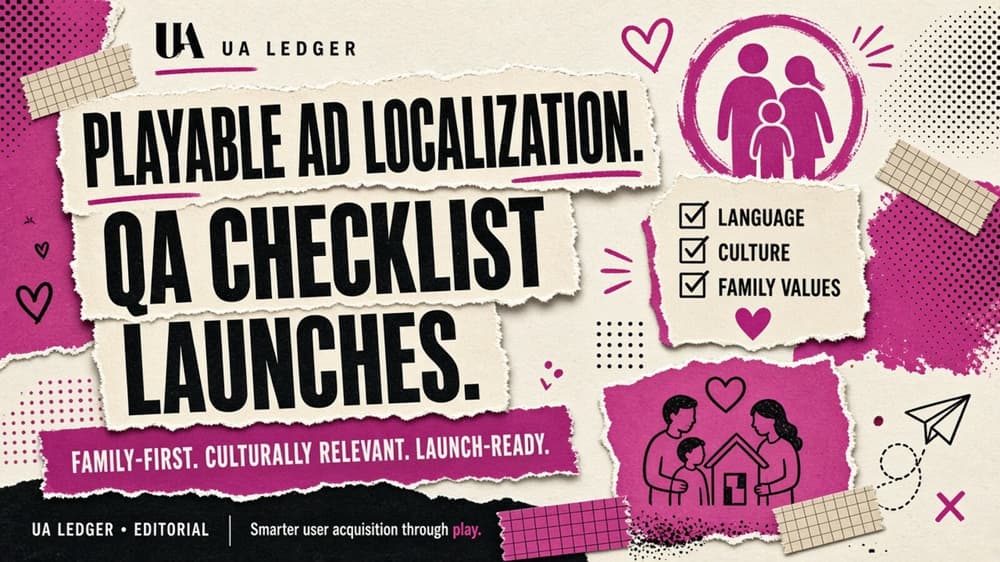
A playable ad localization QA checklist catches truncated text, mistimed voiceover and gesture mismatches before a market launch, not after.
A playable ad that passes QA in English and then gets pushed to twelve markets with a batch translation and no second look isn't localised. It's translated. The difference shows up in the metrics within a week: truncated buttons, voiceover that no longer matches on-screen timing, gesture prompts that read backwards in a right-to-left layout. Those are the most common failures, and every one of them is catchable before launch with a checklist rather than after launch with a performance postmortem.
Why translation and localization QA are different jobs
Translation changes the words. Localization QA checks whether the changed words still fit the container the designer sized for them, whether the interaction model still makes sense to a player in that market, and whether anything timed to the original language's pacing still lines up. A playable's UI elements fit source-language text length and nothing else. German and Finnish routinely run 20 to 35% longer than English for the same meaning; Japanese and Korean can run shorter but change line-wrapping behaviour entirely. A button that fit "Play Now" comfortably can clip "Jetzt Spielen", or force a font size reduction that makes the call to action harder to tap on a small screen, which is exactly the kind of defect that never shows up in a design review and always shows up in a CTR drop.
The checklist to run before any market goes live
Before a localized build ships to any network, run through this list against the actual build, not the source-language reference:
- Every button and label fits its container at full size without auto-shrinking below a readable minimum, checked on the smallest supported screen size, not just a design mockup.
- Voiceover or on-screen instruction timing still matches the interaction it is guiding, re-timed rather than just re-recorded if the translated script runs longer or shorter than source.
- Right-to-left languages, most commonly Arabic and Hebrew, have a genuinely mirrored layout, not just mirrored text, including swipe direction prompts and any left-to-right progress indicators that need to run the other way.
- Numerals, currency symbols, and date formats match local convention rather than being carried over from the source build, particularly in any end card that shows a price or an offer.
- Cultural or content sensitivities specific to the market, such as colour associations, gestures, or imagery, have been reviewed by someone with market knowledge, not assumed safe because they passed in the source market.
- The build has been tested on at least one lower-spec device common in the target market, since load time and frame rate issues compound with anything that increases asset size, such as longer voiceover files or additional character sets.
- App store or ad network content guidelines specific to that market or region, which sometimes differ from global policy, have been checked against the localized build's actual content, not just its category.
None of these are exotic checks. All of them get skipped when a studio treats localization as a translation vendor deliverable rather than a QA gate with the same rigour as the source build's own submission process.
Where the process usually breaks
The most common failure in this checklist isn't any single item; it's sequencing. Studios translate text, hand a translated string sheet back to the ad network or an outsourced build team, and treat the localized build as a language swap on an otherwise-finished asset rather than as a new build that needs its own QA pass. The right sequencing puts localization QA at the same stage as the original build's device testing matrix, run against the specific market's common devices and network conditions, not as a final rubber stamp once the string swap is technically complete.
As "Localisation Inside the Playable Ad: Text, Gesture, Pacing" argued earlier this year, the interaction model itself, not just the text inside it, sometimes needs a market-specific adjustment. A tap-and-drag gesture that reads naturally to a player in one market can read as unclear or even rude in another if it borrows a gesture with unrelated cultural meaning. That's a design review question. It isn't a string-length question, and it's why localization QA needs someone with market fluency in the loop, not just a linguist checking translation accuracy against the source script.
Who actually owns each check
A checklist without a named owner for each item degrades into a shared assumption that someone else is handling it. In practice the split looks like this. Layout and text-fit checks belong with whoever builds the localized creative. Timing and voiceover sync checks belong with whoever manages the audio vendor. Cultural and content sensitivity review belongs with someone who has genuine market fluency, whether that's an in-market contractor, a regional publishing partner or a member of the studio's own team from that region, and content and policy checks belong with whoever manages the network relationship for that market, since ad network guidelines can differ by region even under the same global policy document. Splitting ownership this explicitly, rather than treating localization QA as one undifferentiated task, is what keeps the checklist from landing on a single overloaded person during a busy launch week.
Building the checklist into the release calendar
The practical fix is treating each new market as its own mini-launch with its own QA sign-off, scheduled with enough lead time that a failed check doesn't become a choice between shipping a known defect or missing a campaign start date. A studio expanding into five new markets this quarter should budget QA time per market, not per build. The checklist above takes real device time to run properly, and nobody can compress it by running it once against the source build and assuming it generalises. Markets that get this sequencing right at launch spend far less time later diagnosing why a specific geography's CTR or completion rate sits well below the others, because the answer is usually sitting in one of the items on this list.