The budget conversation: how to defend a UA line in a flat market
By Jordan Wells, Senior Analyst — Archive date: 4 min read
View author profile
Sensor Tower puts mobile game IAP growth at 1.3% for the year. An operating brief on defending a UA budget when more spend no longer means more revenue.
State the backdrop plainly before getting anywhere near tactics: Sensor Tower's State of Mobile 2026 put global mobile game in-app purchase revenue at roughly $82 billion, up 1.3% year on year, the third straight year of growth and by a wide margin the smallest of the three. The same report describes downloads as softening, so a finance partner reading it sees a market that has essentially stopped growing on the metric that used to justify a UA increase almost automatically, and that changes the conversation a UA lead has to walk into.
The old pitch doesn't work in a flat market
The old pitch, more budget produces more installs which produces more revenue, was never entirely true. It held up while the market expanded fast enough to hide the difference between good spend and mediocre spend. Flat markets remove that cover. A finance stakeholder will reasonably ask why UA spend should hold steady or grow when the category-wide revenue line it serves is barely moving. Answering that needs a different argument from the one most UA teams have leaned on for years.
The argument for defending the budget
The argument that holds up is about mix rather than volume. Sensor Tower's own data shows the shift already under way: creative formats are moving toward video, now 53.7% of creative share, while playables have nearly doubled their share to 13.3%. That describes a market where the winners extract more value per install and per creative instead of simply buying more installs. Defended on those terms, the line isn't there to grow the top line by adding volume into a market that has stopped expanding; it's there to protect and grow the lifetime value of the cohorts the team already acquires through better targeting and a better creative mix, with tighter control of cohort quality behind both.
That reframing carries requirements if it's going to survive a finance review. Walk in with cohort-level payback data rather than blended install cost. Show which creative formats and which audiences produce cohorts with better long-run value, not merely cheaper installs. And be honest about where spend has been buying volume out of habit. A finance partner who finds that waste first will use it against the whole budget rather than the wasted slice of it. None of this makes the conversation comfortable. A flat market takes away the easiest argument a UA lead has (more spend equals more revenue) and hands back a harder one that has to hold up against data every quarter instead of an assumption nobody checks.
It is the argument the evidence currently supports, and defending a budget on a claim the market has stopped backing up is a worse place to stand when the review comes round. There is also a timing advantage in making the shift before someone forces it. A UA team that starts reporting on cohort value and creative mix voluntarily, ahead of the finance review that would eventually demand it, controls the framing of its own numbers.
A team that waits until finance challenges the budget is reacting to someone else's read of a flat market, usually a more skeptical read than the UA team would have picked for itself. The reports already in circulation, showing revenue barely moving while creative volume rises across the industry, aren't going away this quarter, and getting ahead of what they imply about one specific budget costs less than explaining after the fact why a line item failed to adapt to a market everyone else had already read correctly.
Related archive reading
These articles provide related context and remain subject to their stated review status.
Featured
Related posts
market intelligence
media buying
·1 min read
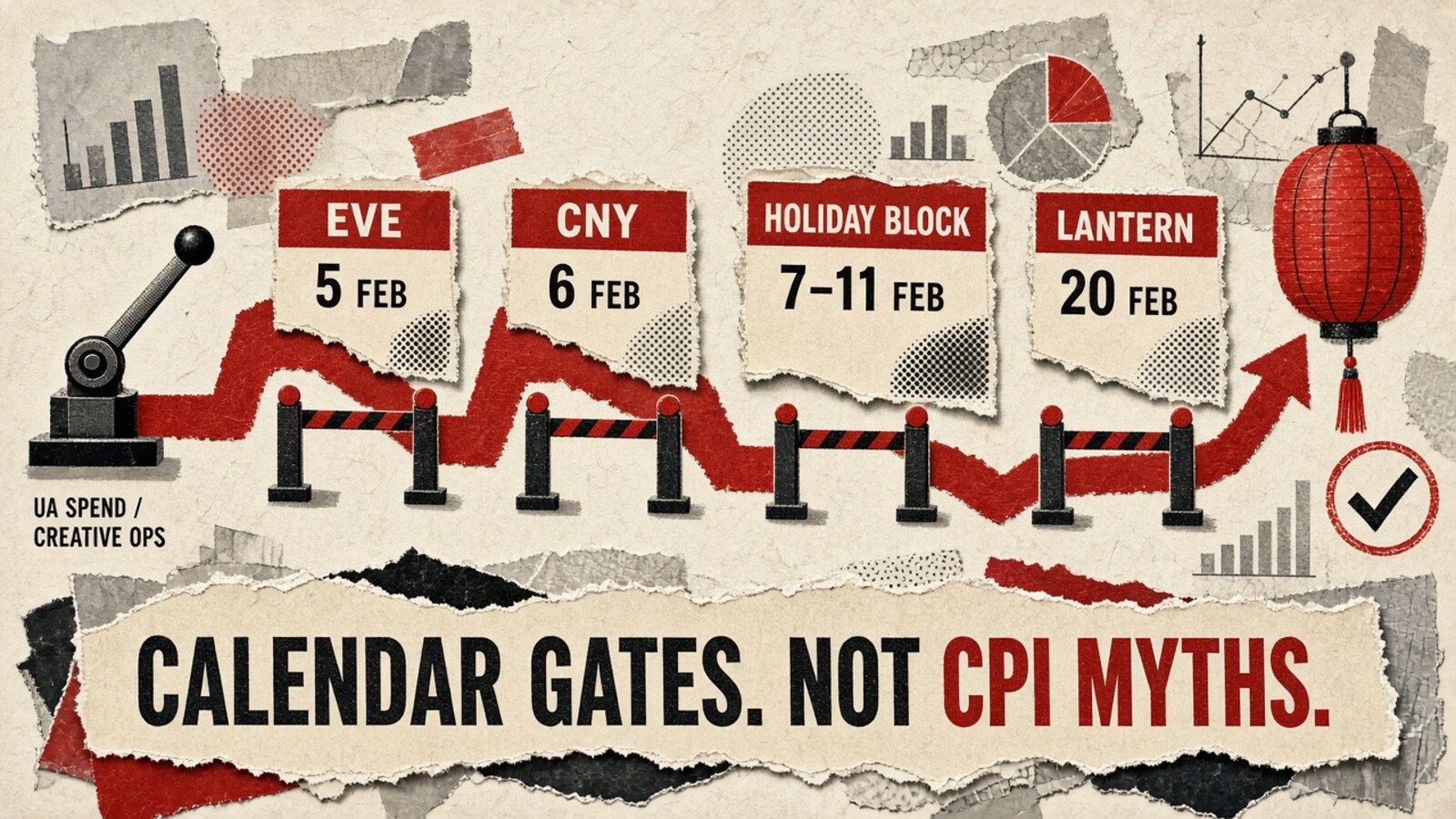
Lunar New Year UA gates from an official calendar, not a CPI myth
market intelligence
media buying
·2 min read
WeChat Mini Games upgrades 2026 IAP / virtual-payment incentives for debut titles
market intelligence
media buying
·2 min read
WeChat Mini Games IAA incentives from 20 August 2026: 3-minute lifetime, 180-day option
market intelligence
media buying
·3 min read
WeChat mini-game virtual-payment incentives for 2026: 60% cash, launch bonuses, 22 Sep account lock
More from the Market Intelligence desk
creative strategy
market intelligence
·1 min read
Ramadan: creative hours and store localisation checks
market intelligence
measurement
·1 min read
Retention percentile charts for F2P: what GameAnalytics-style cuts miss
market intelligence
platforms
·2 min read
Vietnam Decree 147 takes effect 25 December 2024 — ad and licensing gate goes live
market intelligence
platforms
·2 min read